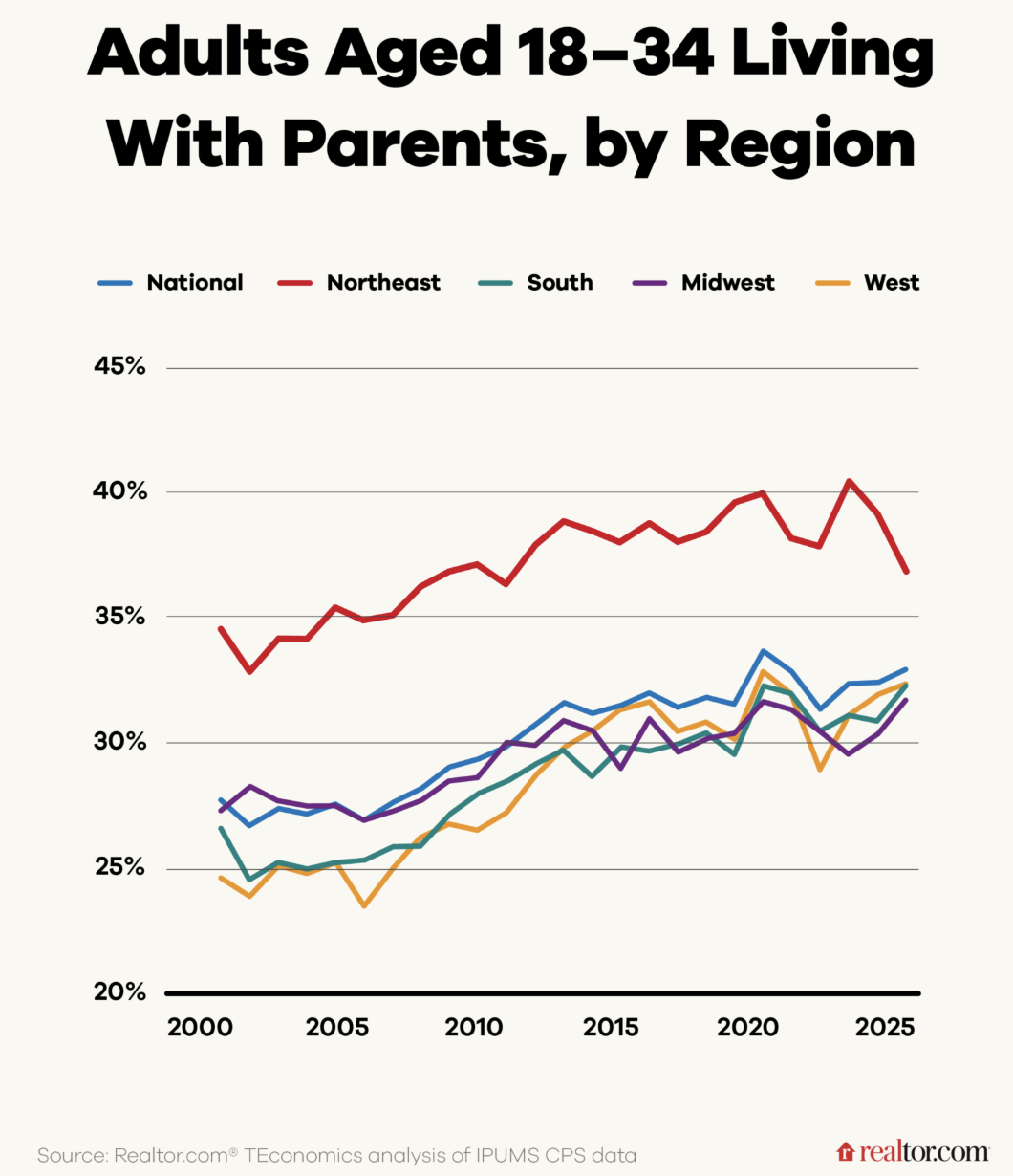
Thanksgiving often marks a hectic travel period. For an increasing number of young adults, the journey home involves only a short walk from their childhood rooms. A report from Realtor.com highlights that regions known for affordable housing are attracting young adults moving back with their parents. In 2025, the share of 18- to 34-year-olds living at home rose by 1.4 percentage points in both the South and the Midwest, reaching 32.3% and 31.7% respectively. These represented the most significant increases nationwide. Conversely, in the Northeast, where multigenerational living is traditionally prevalent, the percentage decreased by 2.3 points to 36.9%, the lowest since 2010.
Hannah Jones, a senior economist at Realtor.com, emphasized that this trend extends beyond coastal areas to more accessible regions. National figures reveal that 25.2 million young adults lived with their parents last year, equating to about one-third of this demographic. Data from Boston College’s Center for Retirement Research, by Geoffrey Sanzenbacher, also points out a rise in parents living with their 25- to 34-year-old children, climbing from 1.6% in 1996 to 4% in 2025. In 2024, 22% of Americans resided in multigenerational households, compared to 13% in 1970. Pew Research Center found financial issues as a major reason for such living arrangements, cited by 40% of respondents.
The National Association of Realtors indicated that 14% of homebuyers purchased multigenerational homes in the year ending June. The main reason, at 30%, was to care for aging parents, followed by saving money (23%), adult children who remained at home (19%), and those returning (18%). Tim Yee from RE/MAX Gold noted increasing interest in homes with accessory dwelling units in the Bay Area. These units help families stay close while maintaining independence.
San Antonio saw heightened interest in multigenerational living, with these homes receiving 65.2% more page views than standard listings in 2025. However, their median asking price was $573,105, nearly 69% higher than average. Affordable regions like the Midwest and South experienced the largest increases in this trend.
Despite more homes entering the market, the issue persists. San Antonio’s active listings are over 40% above pre-pandemic levels, yet young adults living at home still rise. Jones noted that markets with supply growth focused on mid-to-upper tiers make it hard for entry-level households to compete, particularly young adults struggling with high prices and rates.
Leave a Reply