Deciding whether to expand into new markets depends largely on the potential customer base. Surveys in India and Mexico reveal an interesting trend: households shift from using motorbikes to cars when their expenses reach roughly $1,200 monthly, or $300 per person, based on current market values.
By 2036, around 850 million additional people in emerging economies will be spending over $300 a month, making them prime candidates for car services. Approximately half of this growth will occur in India and China, with countries like Indonesia, Vietnam, the Philippines, and Bangladesh contributing another 125 million individuals. Among these new consumers will be about 200 million Gen Z members and around 420 million women.
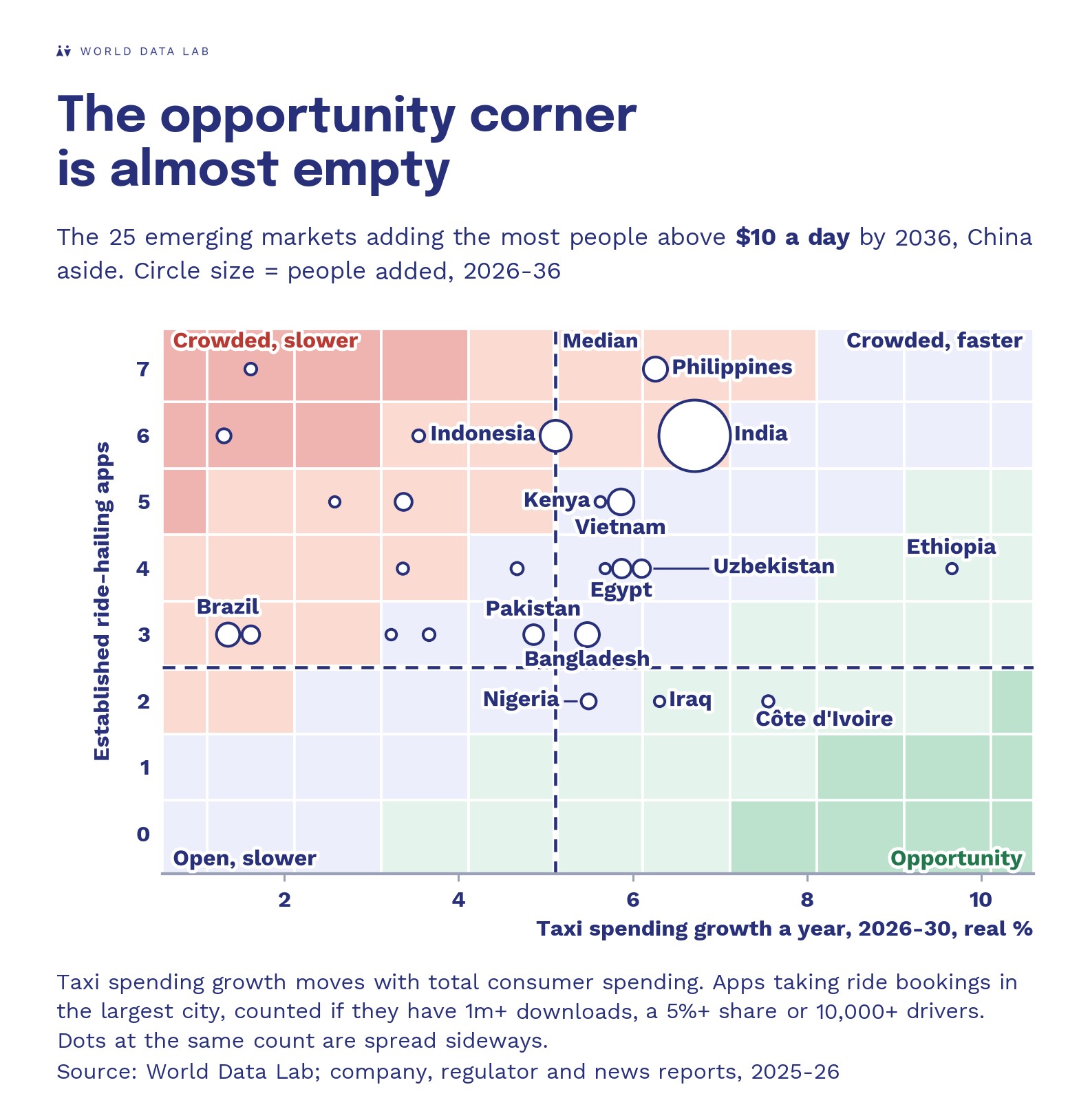
However, the challenge lies in the saturation of these markets. Almost 90% of potential new users will be in regions where a few established companies already compete. An app is considered established if it boasts over a million downloads, handles 5% of the local ride market, or has 10,000 drivers. In the 25 emerging markets predicted to gain the most customers, only places like Iraq, Nigeria, and Côte d’Ivoire have less than three established apps in their main city.
Even where rapid growth is expected, markets can become saturated quickly. For instance, in Kenya, taxi industry revenues are expected to grow nearly 6% annually, yet Nairobi already supports five booking apps. Ethiopia, one of the fastest-growing markets, is home to four apps.
Smaller markets present opportunities, though they aren’t large enough to offer significant growth. New entrants are targeting regions like Namibia, Botswana, and Mozambique, which will see an increase of about 2 million people spending over $300 monthly by 2036. In contrast, nations like Nigeria, Egypt, South Africa, and Kenya anticipate about 35 million such consumers.
While major metro areas will add the highest numbers of new consumers outside of China, smaller cities will see the fastest growth. Secondary cities, such as Patna in India and Can Tho in Vietnam, are expected to more than quadruple their consumer base.
In bustling markets, the ride-hailing sector offers value beyond mere transportation. In these regions, expenditure on dining is predicted to double to about $3 trillion yearly by 2036, outpacing grocery spending. Gen Z allocates about 6.1% of their budget to dining out and 3.3% to ride services. In comparison, people aged 45 to 64 spend 5.5% and 2.6%, respectively.
As Gen Z’s purchasing power grows, spending on dining and transportation will follow. Over two-thirds of Southeast Asians earning at least $300 monthly will shop online by 2036, an increase from about half today. Many will continue using the same apps for both ordering food and booking rides.
The lack of untapped markets might seem concerning, yet crowded regions still offer significant growth potential. Riders tend to spend more on premium rides as their income rises, not only because of increased rider numbers. In India, the Philippines, and Brazil, the proportion of households using car rides jumps from 4% among the lower middle class to 20% among the affluent.
Currently affordable rides are not simply cut-rate services. They act as a gateway. Those opting for economical motorbike rides today are likely to become car service users when their spending exceeds $300 monthly. If income growth follows projections, most future car bookings will come from today’s budget riders. These consumers mostly reside in regions already served by existing apps.
New geographic markets might sound promising in earnings discussions, but they add few users. For ride-hailing providers, success hinges on converting budget riders. The real questions are how many of these riders will afford costlier rides, when this shift will occur, and the locations of these transitions.
Leave a Reply