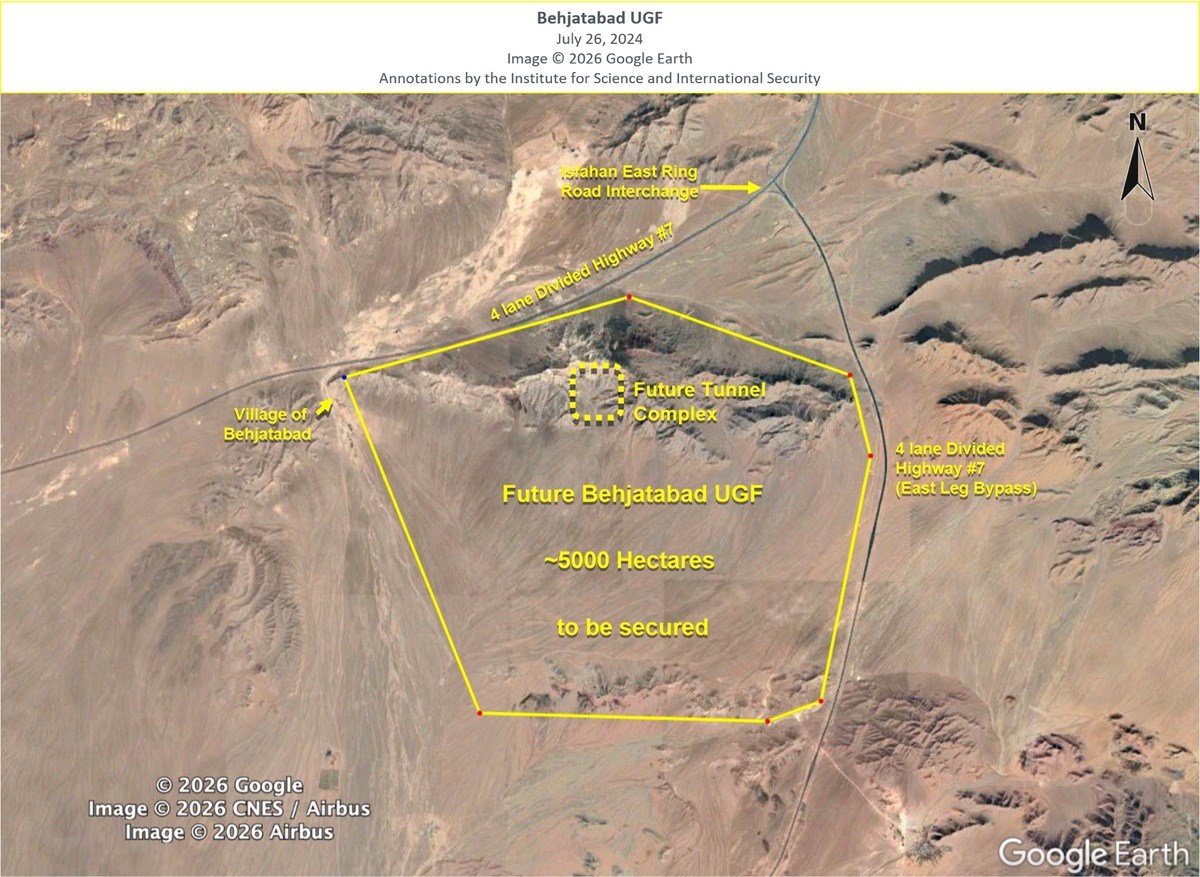
Recent analysis has revealed Iran’s rapid development at a newly identified site between two critical nuclear facilities. This location, near Behjatabad, positioned centrally between the Isfahan and Natanz nuclear sites in central Iran, is being enclosed by a security fence. Experts from the Washington, D.C.-based Institute for Science and International Security (ISIS) shared this development via social media.
The facility, located medially between the Isfahan nuclear location and Pickaxe Mountain near Natanz, spans approximately 62 kilometers, or 40 miles, in each direction. Natanz, known as Iran’s largest uranium enrichment facility, suffered an attack from the U.S. during June 2025 and during the conflict starting February 2026.
Iran has an enrichment plant at Isfahan, featuring multiple buildings such as a chemical laboratory, a reactor fuel manufacturing plant, and a centrifuge workshop. It is thought to contain a vast tunnel network, which potentially stores much of Iran’s highly enriched uranium stockpile. Currently, Iran possesses over 970 pounds of uranium enriched to 60 percent, close to weapons-grade material.
The forthcoming Behjatabad mountain site is anticipated to cover 19 square miles, although its role remains unclear. Sam Lair, a research analyst at the Foreign Policy Research Institute, suggests it could be a missile base for Iran’s Islamic Revolutionary Guards Corps (IRGC), given its resemblance to existing facilities. The purpose, however, remains uncertain.
Visible construction commenced in December 2025, with subsequent infrastructure developments, including a road connecting an administrative area to the developing tunnel network. By April 2026, a tunnel emerged on the site’s eastern boundary, with another becoming visible in the west two months later.
Satellite images from November 24, 2026, annotated by ISIS, show numerous security checkpoints, a perimeter wall, active tunnel entrances, and a potential explosives storage patch. The rapid construction pace hints at possible nuclear activity, although this remains inconclusive.
In response to these developments, Newsweek has contacted the White House and the Iranian foreign ministry for comments. Iran typically buries sensitive nuclear sites or embeds them in mountains to protect them from adversarial attacks and obscure intelligence efforts.
Former President Trump has mentioned the potential of resuming large-scale military operations against Iran. He hinted at striking Pickaxe Mountain, pending White House approval, despite observing minimal recent activity there. Trump emphasized the U.S. would target Pickaxe Mountain if action were taken.
Pickaxe Mountain, or Mount Kolang, stands heavily fortified, over a mile from Natanz, and extends up to 100 meters underground. Despite Iran’s denial of current nuclear activity there, the International Atomic Energy Agency (IAEA) has been barred from this location. Tehran has indicated plans for nuclear activities at the site since 2020. Analysts argue that the facility’s depth perhaps resists even the most powerful U.S. non-nuclear bombs, such as the GBU-57 Massive Ordnance Penetrator.
In June 2025, U.S. B-2 bombers deployed 14 GBU-57s on Iran’s Fordow and Natanz sites but not on Pickaxe Mountain. Satellite imagery has depicted ongoing construction at Pickaxe Mountain, including a security fence around it and reinforcement of tunnel entrances, since mid-2025.
Editors Henry Holloway and Cristina Diciu contributed to this report.
Leave a Reply