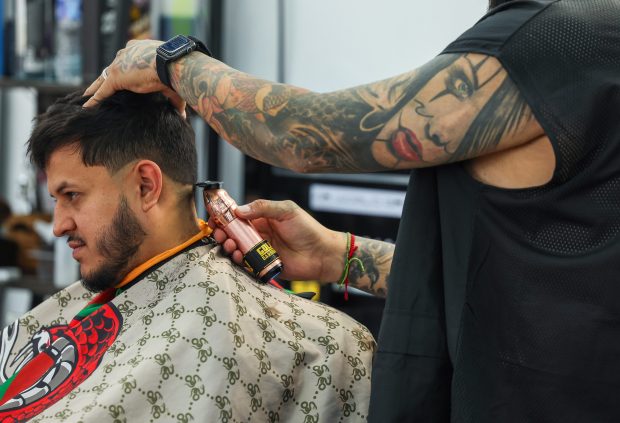
When federal immigration officers swept through Chicago neighborhoods last fall, the local economy experienced significant challenges. Erick Camargo, who runs a hair salon in Chicago, noticed a dramatic drop in clientele. His business on Diversey Avenue went from seeing around 40 customers a day down to as few as five. During the peak of Operation Midway Blitz, Camargo had to lock the salon doors to prevent agents from entering, while some barbers opted to work from home instead. Customers who continued visiting Epic Studio Barbers & Stylist arrived alone, quickly making their way from vehicles to avoid confrontation with immigration officers. Among locals detained were two familiar faces: a boy selling chocolate for his blind parents and a woman selling tamales on the street, both unheard from since their detention.
Camargo empathized with clients avoiding the salon, dissuading them from risky decisions that might lead to unforeseen consequences. The aftermath of the raids still reverberates across Chicago’s predominantly immigrant neighborhoods, compelling Illinois lawmakers to consider assistance measures for struggling businesses. Two proposals have been introduced. The first suggests a grant program of $50 million managed by the Illinois Department of Commerce and Economic Opportunity. The second proposal, which has passed the House, proposes a loan plan for small businesses during periods of ‘economic shocks,’ characterized by diminished foot traffic, declining sales, workforce disruptions, and business closures.
This loan framework mirrors models adopted by other states post-COVID-19, offering loans up to $50,000 with a fixed 2% interest over five years, initially deferring repayment for six months. Both measures aim to aid small businesses. The grant initiative limits eligibility to businesses with fewer than 25 employees, while the loan program covers companies with a workforce below 50 and annual revenues under $3 million. Camargo believes his salon could benefit from these initiatives.
Despite surviving due to personal savings and a gradual return of customers, Camargo’s salon operations continue to lag behind pre-raid levels. “Bills don’t wait,” he remarked, highlighting increased cost burdens. Democratic Senator Mike Simmons from Chicago, endorsing the grant proposal, emphasized the importance of addressing the sustained trauma from ICE raids, advocating against businesses incurring debt given the lack of capital.
Nevertheless, these proposals face an uphill battle. Governor JB Pritzker’s February budget proposal did not earmark considerable additional spending. With limited time remaining in the legislative session, budget priorities and a looming deficit pose challenges. The spokesperson for the DCEO, Eliza Glezer, expressed general support for aiding small businesses, while refraining from a definitive commitment.
Efforts to support businesses hit by immigration sweeps aren’t exclusive to Illinois. A Los Angeles County review revealed that 44% of surveyed businesses lost over half their revenue post-local immigration raids. Minneapolis reported a loss of $81 million in January tied to a similar federal operation called Operation Metro Surge. The Minnesota Senate Democrats approved a $100 million support loan program for affected businesses, although it remains stalled in the House.
“A really tough situation,”
The Chicago raids, said to focus on criminal immigrants, led to nearly 2,500 deportations and roughly 3,800 arrests, most of which involved individuals without criminal records. A Chicago Tribune analysis discovered that only 1.5% of those arrested had a history of violent offenses. President Donald Trump had depicted Chicago negatively, criticizing local sanctuary policies implemented by Pritzker as unsafe.
Economic repercussions were swift across Chicagoland. Marcos Carbajal from Carnitas Uruapan, a family-owned Mexican restaurant in the Pilsen neighborhood, described the situation as a “nightmare.” Sales at their Pilsen and Gage Park sites declined by 25% to 30%. A newly opened location in Little Village, referred to as the “Mexico of the Midwest,” saw a 40% sales drop due to federal raids, which included arrests of several individuals, including street vendors and U.S. citizens.
Carbajal deployed protective measures, reduced hours, cut costs, and relied on reserve funds to endure the crisis, yet remained financially strained. “I think there are a lot of people who’ve left our industry who, if they felt safe and comfortable, might have stayed in the industry,” he noted.
The specific financial impact remains uncertain, but Hilda Alvarez Rodriguez from the Illinois Hispanic Chamber of Commerce indicated that most businesses in Chicago suffered. She remarked that the operation’s conclusion in early November came amidst challenging winter conditions and burgeoning national inflation.
Andres Solarte from the chamber noted that clarity on revenue declines would improve once Illinois and Cook County reviewed business tax filings later in the year. Solarte believes the loan program can help Chicago businesses achieve pre-pandemic foot traffic levels while maintaining state readiness for economic unpredictability. “They don’t need a handout,” Solarte emphasized. “They just need to be able to weather the storm.”
Leave a Reply