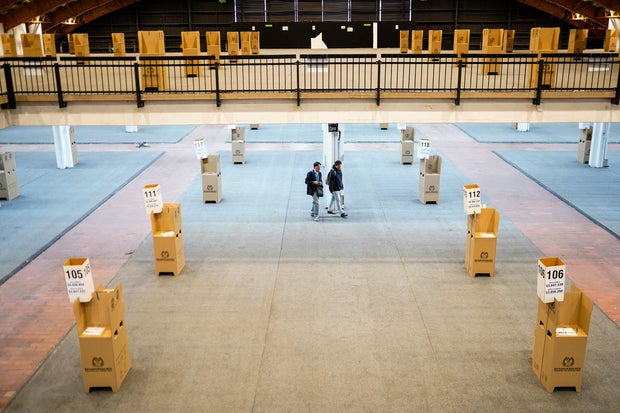
On Sunday, millions of Colombians will vote in a crucial presidential election that will likely lead to a runoff between two markedly different candidates. While a new president could emerge, none of the candidates are expected to surpass the 50% vote threshold needed to win outright in the first round. Consequently, a second round between the leading candidates is nearly assured on June 21.
Among the 14 candidates, three have emerged as the main contenders. On the far left is Senator Iván Cepeda, representing the ruling Pacto Histórico party and following in the footsteps of President Gustavo Petro’s policies. From the far right, lawyer Abelardo de la Espriella has modeled his approach on leaders like President Trump and El Salvador’s Nayib Bukele. Positioned as a center-right choice is Senator Paloma Valencia, backed by former President Álvaro Uribe.
Recent polling from AtlasIntel indicates that Cepeda narrowly leads the first round with 38.7% over de la Espriella’s 37.3%. Both have a significant lead over Valencia’s 14.3%, while moderate candidate Sergio Fajardo, a former mayor of Medellin, trails behind. According to the poll, Cepeda would lose in a runoff against any of these three contenders.
Security and Peace Policies
Voters in Colombia are seeking solutions to end violence and address security concerns. Many communities near coca fields, the plant used to make cocaine, have suffered from ineffective peace negotiations that increase danger in their areas. Over 50 massacres have occurred this year alone, including a recent clash leaving around 50 dead. Petro’s peace policies have inadvertently expanded the power and membership of armed criminal groups.
The candidates have differing visions for addressing these issues. De la Espriella is a forceful contender with a dramatic campaign style, proposing harsh measures such as bombing traffickers’ camps and resuming aerial fumigation of coca fields. He also plans to build 10 maximum-security private megaprisons. Meanwhile, Cepeda supports negotiations with criminal groups, despite accusations of ties to FARC guerillas, which he denies. Valencia advocates a balanced approach, calling for increased military presence and technological surveillance alongside fumigation.
Economic and Election Concerns
Economic issues also drive voters to the polls. Business owners have felt the strain of significant minimum wage increases and are eager to see what changes a new government might bring. Voting security remains a concern in rural areas, where armed groups have reportedly intimidated voters.
Recently, Colombia’s most powerful drug lord warned against advancing right-leaning policies, which he linked to potential violence. Cepeda has publicly rejected any intimidation attempts by armed groups, regardless of their intended impact on his campaign.
Impact on U.S. Relations
The outcome of this election may significantly affect Colombia’s relationship with the United States. Under President Trump, the U.S. has maintained aggressive counternarcotics operations and aligned with regional right-wing governments. Trump’s administration has built strong partnerships with countries like Ecuador to combat drug cartels.
However, U.S.-Colombia relations have strained under President Petro, resulting in revoked visas and sanctions against him. Despite these tensions, Petro has claimed record drug seizures, which the U.N. contradicts with reports of increased cocaine production. The stakes are high, as Colombia remains a key U.S. ally in the Western Hemisphere, both in trade and in the fight against the drug trade.
Leave a Reply