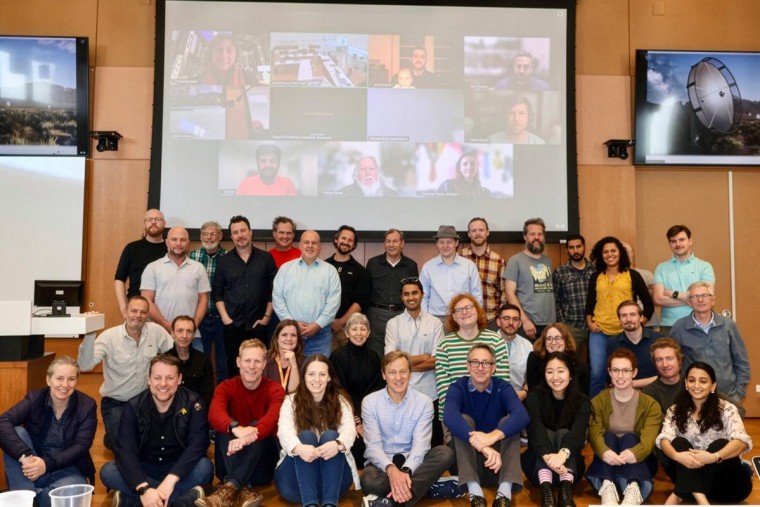
In the remote expanse of Nevada’s Great Basin, an unprecedented radio telescope project is underway. Spearheaded by the California Institute of Technology, this ambitious endeavor known as the Deep Synoptic Array involves the construction of 1,650 individual radio dishes. These components will collectively focus on studying cosmic phenomena such as supermassive black holes, pulsars, and fast radio bursts.
Unique Project Characteristics
Gregg Hallinan, a Caltech professor of astronomy and principal investigator for the project, emphasized the uniqueness of this venture. The sheer quantity of antennas sets it apart from any existing telescope.
Radio telescopes capture naturally occurring radio waves from stars, planets, galaxies, and more. By analyzing the patterns of these emissions, astronomers can gain insights into the structure, composition, and temperature of these celestial objects. Though radio telescopes don’t capture images like optical observatories, they convert radio signals into data that can create images.
Capabilities and Impact
The Deep Synoptic Array promises to outpace earlier ground-based radio telescopes, offering unmatched survey speed and image quality. Hallinan states that this array will double the known radio sources in the universe, achieving this feat within its first 24 hours of operation. The project expects to finalize construction by 2029, aiming to analyze the sky quickly and precisely.
Each dish across this array measures approximately 20 feet. Combined, they will form one of the world’s largest radio telescope arrays, covering over 123 square miles in White Pine County, a region managed by the Bureau of Land Management. Hallinan reports that the project is in the permitting phase, with construction possibly starting next year.
Comparative Analysis
Ground-based radio astronomy typically uses either single large dishes or arrays of smaller dishes. An example is the Green Bank Telescope in West Virginia with its massive 328-foot dish. In contrast, New Mexico’s Very Large Array consists of 27 smaller dishes in a Y-shaped configuration. While single dishes offer greater sensitivity to faint radio waves, larger arrays excel in image sharpness. The Deep Synoptic Array aims to harness both advantages.
Alongside Professor Vikram Ravi, Hallinan described the array’s potential to transform radio astronomy. Where formerly astronomers had mere sketches, the array’s capabilities will produce photographic-quality observations. This transformation stems from the array’s capacity to frequently scan large universe segments.
Future Research and Funding
Anticipated research includes five major sky surveys. Once the array identifies interesting radio emissions, other telescopes, including optical, infrared, and X-ray observatories, can target these emissions for deeper analysis.
Project funding was provided by the Schmidt Sciences philanthropic organization, established by Eric Schmidt, former Google CEO, and Wendy Schmidt. Eric Schmidt recently became the CEO of Relativity Space, which secured a significant NASA contract to deliver science instruments to Mars in 2028.
Site Selection and Challenges
Hallinan and colleagues undertook a meticulous site selection across the American West to minimize radio frequency interference. The Great Basin’s natural geographic characteristics made it an ideal choice. It offers an isolated environment, far removed from electronic interference sources like cell phones and Wi-Fi.
“This telescope is sensitive enough to detect a cellphone as far away as the sun,” Hallinan explained. The quiet valleys and sparse population of White Pine County further confirmed its suitability for radio astronomy.
Leave a Reply