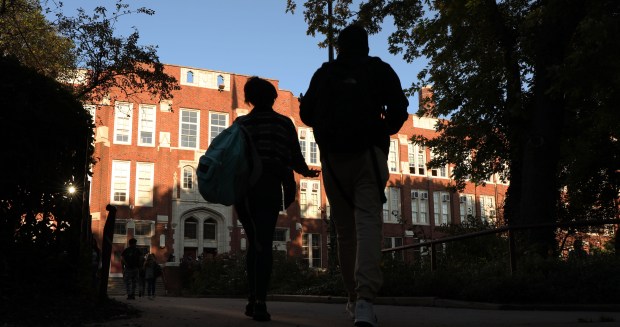
Karen Calloway seeks more financial contributions for Kenwood Academy. Recently, the principal rented the high school’s campus to churches, nonprofits, and sports leagues, and collaborated with a new parent group to raise donations. The Chicago Public Schools (CPS) analysis with Chalkbeat and the Tribune shows Kenwood spent $418,983 in outside funds in fiscal year 2025, up from about $90,000 in 2021.
Kenwood, a mostly Black high school with about half of its students from low-income families, used these funds for athletic gear, student clubs, and college tours. Calloway emphasizes the importance of creating additional revenue streams. Wealthy communities have historically used private fundraising for non-essential school expenses, but more Chicago schools are now using it for essentials due to financial challenges.
District-run schools spent $48 million in independently raised revenue in fiscal year 2025, up 78% from 2021. A district spokesperson indicated the spending was $51.8 million, without clarifying the difference. While North Side schools dominate in attracting outside money, South and West Side campuses like Kenwood are catching up. This effort helps but can detract from instructional improvements, say principals.
Faced with a $732.5 million deficit, CPS made budget cuts due to long-term debt, pension liabilities, and insufficient state funding. Nelson Gerew from the Chicago Public Education Fund notes the scramble for additional revenue and savings as the district approaches a breaking point.
Larger Schools View Fundraising as Essential
Amundsen High School recently used funds for essentials like staff salaries. A decade ago, 90% of Amundsen’s students were low-income and 60% Latino. An effort to attract families from Lincoln Square improved enrollment but tightened budgets. In 2024, the school lost federal funds for disadvantaged students due to a new CPS funding formula. Amundsen spent $894,000 in outside money in 2025 for operations, about 5% of its budget.
Historically, Chicago’s parent fundraising has fueled inequity, favoring wealthier schools. However, some high schools like Amundsen are using outside revenue to fill budget gaps and fund essentials. One North Side principal said without independent revenue, budgets don’t work. Independent revenue accounts for under 1% of total campus budgets but is growing, with schools like Lincoln Park High at 6%.
Schools funded 77 teacher and staff positions using independent revenue, up from 67 in 2024-25. Securing funds involves renting facilities and managing logistics. South and West Side campuses are enhancing fundraising efforts amid a shift in CPS’s funding model to support higher-need schools.
Efforts to Increase Funding at Low-Income Schools
Kenwood’s recent eighth-grade graduation featured a fundraising booth, Friends of Kenwood, offering school merchandise. Alumni and parents, like RyAnn Nelson-Jaiyesimi, purchased items to support the school. Ramona Burress revived parent fundraising during COVID-19 and expanded efforts with wealthier North Side groups’ guidance.
Kenwood raised $55,000 last year, a fraction of what wealthier schools earned, but still important. It collaborates with alumni and businesses for more funds. Rhonda Burress said, “Organizations like ours can help close the gap,” acknowledging the district’s financial challenges.
South and West Side schools, such as Dyett High School and Corliss High School, have increased independently raised revenue, with 40% growth since 2021. The additional funding aids in offering programs common at wealthier schools.
District Encourages Revenue Creativity
In district presentations, principals were advised to use all available funds before requesting budget changes. CPS encourages renting facilities and now takes a percentage for renovations. Cell tower revenue gets split, with schools retaining a portion.
District officials maintain neutrality on schools generating revenue independently but acknowledge the importance of external fundraising. Higher-poverty schools are being supported in their efforts to secure outside revenue. Burress and Espinosa from Amigos de Gunsaulus have met with CPS officials and other schools to share successful fundraising tips.
While contributors urge caution against over-relying on independently raised funds, schools appreciate this financial support, especially with recent budget cuts. At Whitney Young, parents’ fundraising will support teachers for the first time, a sign of the growing need for these funds.
Leave a Reply