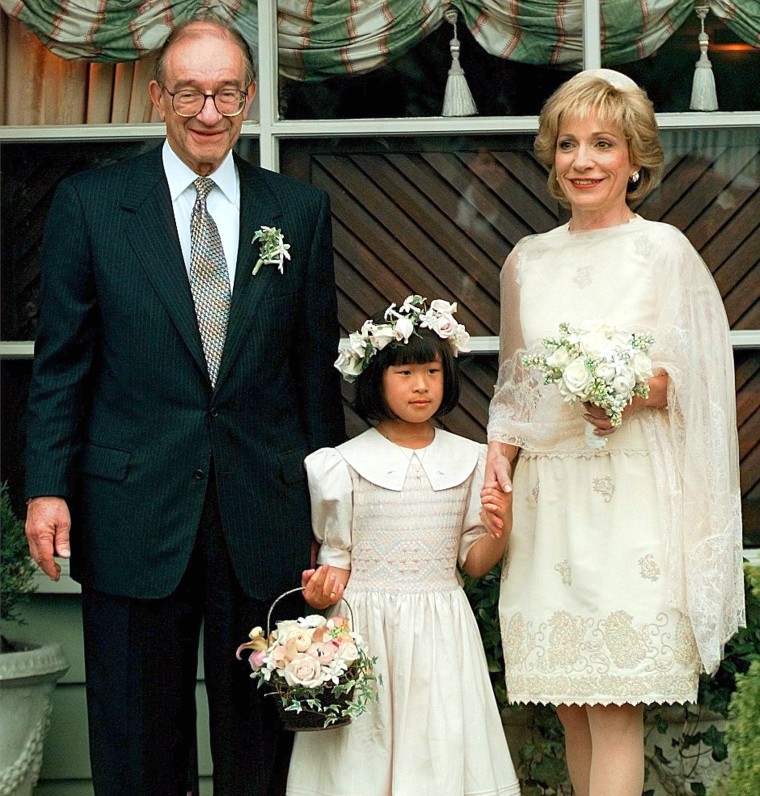
Alan Greenspan, a prominent figure in the world of economics, passed away at 100. His wife, NBC News correspondent Andrea Mitchell, confirmed his death from Parkinson’s complications. Greenspan shaped U.S. monetary policy through five terms as Federal Reserve chairman, serving under four presidents. His tenure saw significant economic expansions and modern American capitalism’s evolution. Despite criticisms linked to decisions preceding the 2007-08 financial crisis, his impact remains substantial.
Greenspan’s career in the Federal Reserve ran from 1987 to 2006. During this period, he managed economic challenges like the 1987 stock market crash and the subsequent liberalization of markets termed the ‘Greenspan put.’ Under his leadership, the U.S. economy underwent one of its longest expansions (1991-2001) and experienced transformative changes from globalization and the digital era. His fame peaked during the stock market boom under President Bill Clinton, earning him titles like ‘America’s least-likely celebrity’ and ‘the maestro.’
Born in 1926 in New York City’s Washington Heights, Greenspan demonstrated early mathematical skills, pursuing economics at New York University. His intellectual journey included associations with novelist Ayn Rand, influencing his economic philosophy. He led Townsend-Greenspan Co., Inc., an economic consulting firm, before entering the political sphere as an adviser to Nixon’s 1968 campaign. Although he worked with Nixon informally, Greenspan held an official role as chairman of the Council of Economic Advisers under President Ford, aiding inflation reduction efforts.
Appointed by President Reagan, Greenspan navigated markets post ‘Black Monday’ (1987). His actions laid groundwork for stabilizing tumultuous market periods. Post-retirement in 2006, Greenspan faced criticism for deregulation leanings linked to the 2007-08 financial crisis, particularly concerning subprime mortgage securities. The Financial Crisis Inquiry Commission cited deregulation under successive administrations as contributing factors.
Authorized several books, Greenspan shared reflections on presidents he served: Nixon’s intelligence, Ford’s kindness, Reagan’s principle-driven leadership, and Clinton’s fiscal acumen. His Republican ties alternated with bipartisan rapport, notably with Clinton, who he humorously labeled ‘the best Republican president we’ve had in a while.’
Greenspan’s legacy spans beyond the Fed. Post-Fed, he founded a consulting firm and received numerous accolades, including France’s Legion of Honor (2000) and an honorary Knighthood from Queen Elizabeth II (2002). President George W. Bush awarded him the Presidential Medal of Freedom (2005).
Leave a Reply