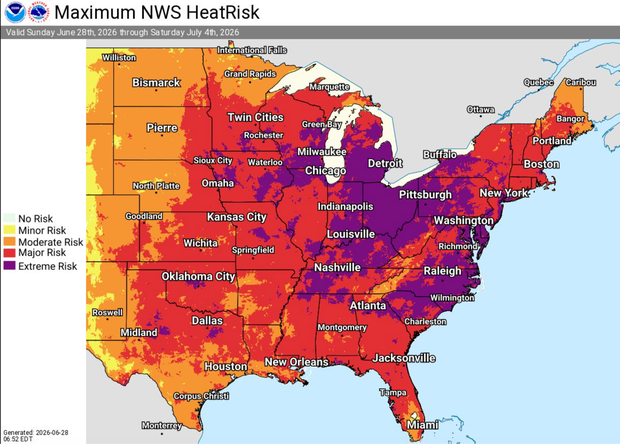
The National Weather Service has warned of a significant heat wave sweeping across a large portion of the United States this week. As July Fourth approaches, temperatures will climb, exacerbated by high humidity.
Regions Affected
Residents in the lower Great Lakes, mid-Atlantic, as well as the Mississippi and Ohio River valleys will experience several days of elevated temperatures. Key cities such as New York, Philadelphia, Washington, Baltimore, Chicago, St. Louis, and Detroit are expected to witness some of the highest temperatures of the year. Southern cities like Dallas, Little Rock, and Memphis will also see soaring temperatures.
Duration and Intensity
The heat is predicted to persist through next weekend, affecting areas in the Great Plains, southeast, and mid-Atlantic. This is the first extensive heat wave of the summer, impacting over half of the country. While the central and eastern U.S. deal with rising temperatures, the Four Corners area remains at risk due to dangerous fire weather conditions.
Severe thunderstorms are hitting the northern Plains and Upper Midwest, with flood warnings extending from the Rockies to the Mid-Atlantic.
Temperature Insights
Forecasted temperatures will reach the 90s and low 100s Fahrenheit (mid to high 30s Celsius). With high humidity, the heat index will range between 100 and 110 degrees F (40 C to 43 C), and could reach 115 F (46 C). Nighttime lows in the 70s F (21 to 26 C) will offer little relief.
Precautionary Measures
The heat index highlights the perceived temperature considering humidity, indicating what might be perilous with extended exposure or vigorous activities. Areas, including Phoenix, Las Vegas, central Texas, and much of the southwest, are already experiencing temperatures around 100 F.
During extreme heat, limit outdoor activities, stay hydrated, and ensure access to air conditioning or cooling locations. The Centers for Disease Control and Prevention caution that heat can affect anyone. Warning signs of heat stress include muscle cramps, dizziness, heavy sweating, shortness of breath, headaches, weakness, and nausea.
Contrasting Temperatures
While much of the U.S. battles high temperatures, parts of the West remain unusually cool, with temperatures 20-35 degrees below average in the Northwest and northern Rockies.
Global Context
Europe is also experiencing high temperatures. Germany recorded a temperature of 106 degrees Fahrenheit over the weekend. Switzerland, the Czech Republic, Denmark, and France are facing similar heat conditions. In France, numerous drowning incidents occurred as people sought relief from the heat in the water.
The heat wave underscores the harsh conditions many are facing globally during this season.
Leave a Reply