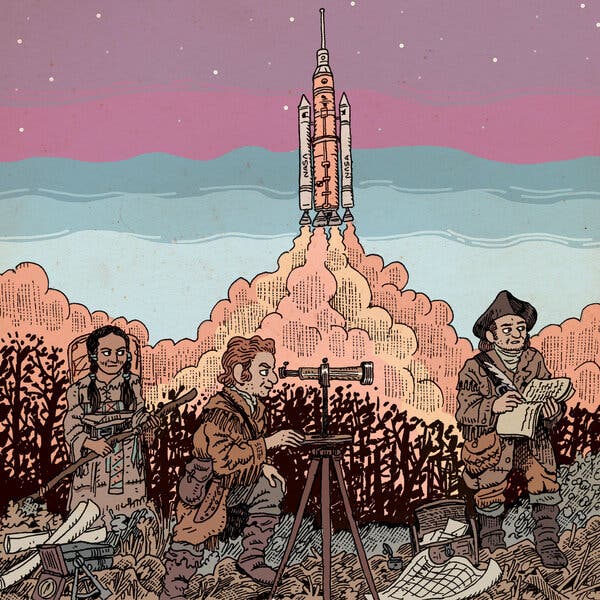
In recent years, the U.S. has witnessed significant financial cuts to scientific research. Last year, the Trump administration paused or canceled 7,840 research grants, affecting scientists mainly funded by the National Science Foundation and the National Institutes of Health, as reported by the journal Nature. Each week seems to introduce new proposed reductions to agencies like the Forest Service and NASA. These cutbacks threaten not just America’s future but also reflect a disconnection with its history of public investments that have contributed to the nation’s development.
The Lewis and Clark Expedition: A Historical Perspective
One of the earliest examples of significant federal research funding was granted to Meriwether Lewis and William Clark. In 1804, they embarked on an expedition to explore a trade route from the Missouri River across the Rocky Mountains to the Pacific Ocean. President Thomas Jefferson had to persuade Congress to finance the mission. From its inception, American politicians have debated research funding.
Jefferson requested $2,500, knowing the expedition would require greater resources. By its conclusion in 1806, the costs had escalated to $38,722.25, as calculated by the War Department. Including all expenses related to the Native diplomats sent to Washington by Lewis and Clark, the total surpassed $100,000.
During this era, the federal budget was approximately $10 million annually. The expedition represented a comparable slice of government spending akin to NASA’s budget in today’s terms.
The Role of Science in the Expedition
A significant portion of funding went towards scientific endeavors. Jefferson instructed Lewis to collect an extensive spectrum of data, involving botany, zoology, geology, climatology, anthropology, economics, and linguistics, among others. Lewis engaged leading minds in America’s scientific community before departing. Jefferson perceived scientists as more suitable to indoor research rather than field expeditions.
Throughout the journey, expedition members contributed to the research. Clark was notable for drawing maps and recording measurements essential for latitude and longitude calculations. Sacajawea, a Shoshone woman, gathered botanical specimens. York, a Black man enslaved by Clark, collected invertebrate specimens. Lewis himself, through his meticulous observation, was pivotal in this comprehensive effort.
Lewis documented various findings, pressing flowers, recording bird calls, and analyzing grizzly bears to measure their hearts—each discovery was rewarding in itself. With an implicit agenda tied to imperial expansion, Jefferson aimed to leverage the collected data internationally and domestically. The expedition’s potential for aiding American territorial claims and expansionary ambitions was evident.
Impact and Unintended Outcomes
The research initiated by Lewis and Clark benefited America vastly, starting with the fur trade. One trader followed Lewis’s guidance, establishing a trading post near the Pacific Coast. However, research’s unpredictability is noteworthy. Clark saw a Native road as a potential wagon route, yet the Oregon Trail later proved more crucial, relying on a mountain pass located further south.
Interestingly, the trader who identified that crucial pass worked with a post established on Lewis’s recommendations, indicating the expedition’s far-reaching influence on westward expansion despite initial predictions.
Leave a Reply