Every day, long wooden boats called shikaras glide across Dal Lake, a well-known lake in South Asia, set against the backdrop of the Himalayan mountains. However, Dal Lake, like many other lakes in Indian-controlled Kashmir, is facing significant issues. Pollution from nearby buildings, invasive plant species, and decreasing water levels due to climate changes are major threats to its future.
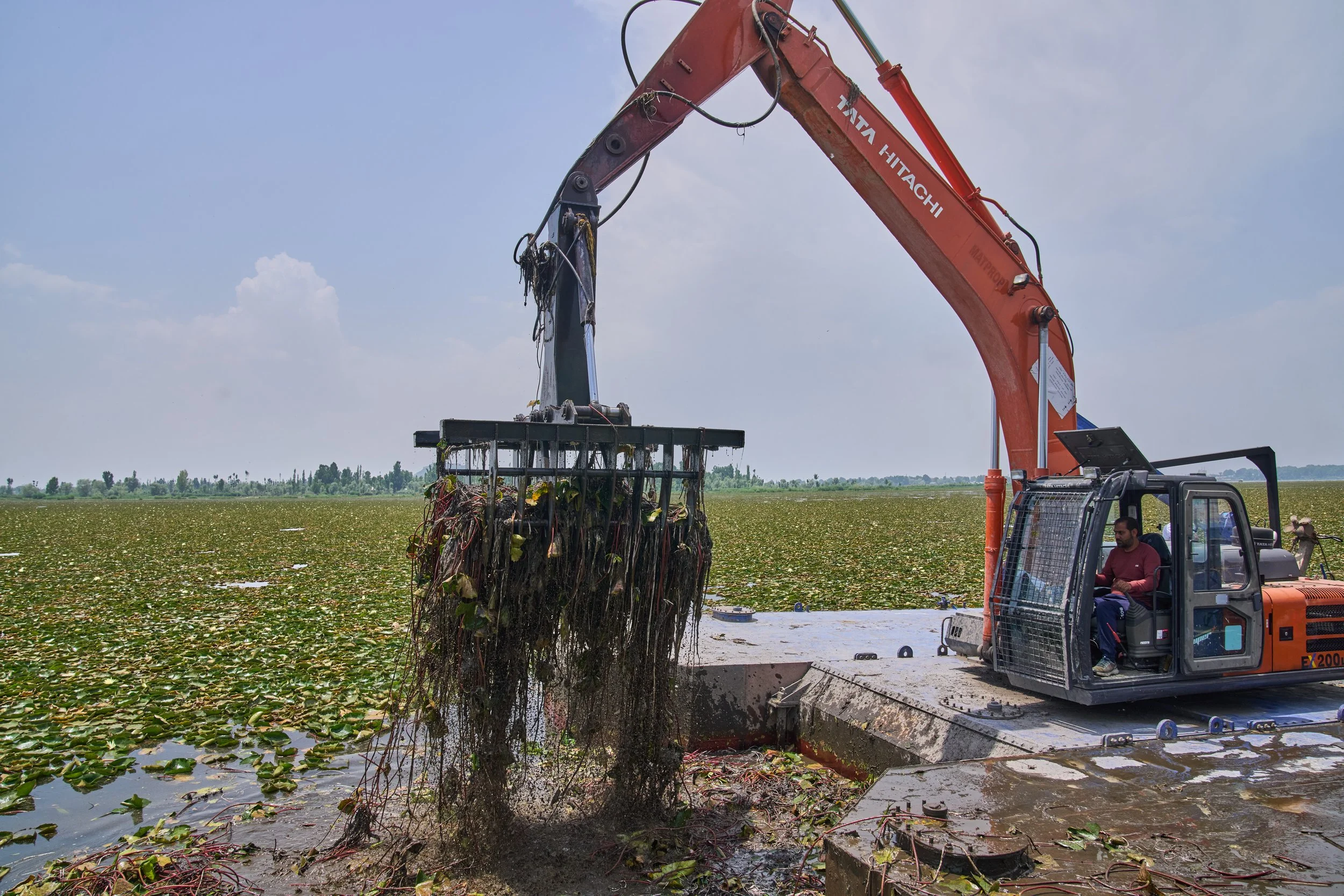
Efforts to maintain Dal Lake rely on workers employed by the local government who continuously clear weeds. They must take precautions to avoid skin irritation from the polluted water. Despite these efforts, Dal Lake receives significant restoration compared to other lakes. For instance, an employee of the Lake Conservation and Management Authority (LCMA) regularly uses machinery to remove weeds from the lake’s waters.
Other lakes, such as Wular Lake, face similar challenges. Residents commute through waters filled with algae and trash. Pollution is evident as women clean blankets in algae-laden waters, and canals near the lake are filled with garbage.
“We are afraid to touch the water with bare hands,” said Ghulam Rasool, a weed cleaner working for the local government.
Rasool noted the difficulty of keeping Dal Lake clean. Sewage drains directly into the lake, and streams from the mountains bring waste such as diapers and garbage. The challenges extend beyond garbage and pollution. According to researchers, many of the region’s lakes have disappeared or become severely polluted due to climate change, unplanned urban development, and unpredictable rainfall.
Figures from an Indian government report show that since 1967, 315 of the region’s 697 natural lakes have disappeared, and 203 have shrunk. Many have turned into marshes or seasonal wetlands, replaced by development such as farmland.
Kashmir’s lakes have always been vibrant with activity. Dal Lake is known for its floating markets selling various goods. Yet, its boundaries have shrunk due to factors like increased sediment from rivers and encroachment by farmland and houses. Small islands and illegal homes are becoming more common.
The impact of human encroachment is visible with livestock grazing on newly formed farmland while traditional fishermen struggle nearby. Untreated sewage contributes to weed growth, feeding off nutrients in the waste. The lakes are littered with garbage, necessitating the work of numerous weed cleaners and heavy machinery to clear the debris.
Local government acknowledges the need for more resources but is making efforts. A government-run authority formed in 1997 involves civil engineers, scientists, and local officials in lake restoration. However, untreated sewage from unconnected houses adds significantly to the pollution.
Climate Change Effects
The Himalayan region is warming faster than the global average. Changes include earlier snowmelt and more intense rainfall, which destabilize the region’s water systems. According to glaciologist Sher Muhammad, these changes create unpredictable water levels in lakes. The melting glaciers initially increase water flow, but over time they reduce natural water storage essential during dry periods.
Environmental scientist Irfan Rashid highlighted the broader economic impacts of climate change on Kashmir, affecting tourism, agriculture, and hydropower. The lakes are crucial for fishing communities, but conditions are declining.
Impact on Fishing Communities
Wular Lake fishermen describe the lake as shallower and fragmented by vegetation. Fisher Abdul Rasheed has seen his income drop drastically due to declining fish numbers, from earning 1,000 rupees a day to just 100 to 200 rupees. Agricultural and residential expansion has worsened water quality, and a previous study found Wular Lake had shrunk by 45% over a century.
Fishers fear that future generations will struggle to sustain themselves from fishing. Bashir Ahmed noted that while young, inexperienced fishermen once caught ample fish, now even skilled fishermen yield minimal catches.
Leave a Reply