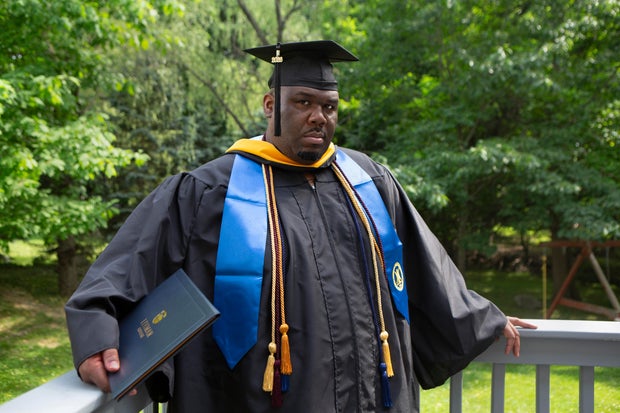
Benjamin Pinckney, 46, has yearned to become a physician assistant since his early 20s. This dream began following a drive-by shooting incident in Jacksonville, Florida, resulting in his hospitalization due to gunshot wounds. During his hospital stay, a physician assistant visited him daily, cautioning that Black men with gunshot wounds often face severe outcomes such as paralysis. This experience was pivotal for Pinckney.
“I was involved in street life,” Pinckney admitted. “He made me promise to never return to the ER like that. That was our final conversation, right before I left the hospital.” From that day forward, Pinckney aspired to follow in the footsteps of the physician assistant.
After dedicating years to the New York City Department of Sanitation and serving as an Army Reserve medic, Pinckney has recently advanced toward his goal. He graduated with departmental honors, attaining a Bachelor of Science degree from Lehman College in May.
Having relocated from New York to Prince George’s County, Maryland, he envisioned applying to physician assistant school this year. However, new federal student loan rules may obstruct his plans. Concerns arise that the impending student loan cap might compel him to seek private loans with higher interest rates.
Starting July 1, the federal government will limit the borrowing amount for graduate students. These changes are part of the One Big Beautiful Bill Act, a piece of legislation signed by then-President Donald Trump. Intended to manage education costs and student loan burdens, the new rules have faced criticism for being insufficient.
The legislation limits students to borrowing $20,500 annually in federal loans because of the definition of a “professional degree”. A federal judge recently blocked enforcing this definition, creating uncertainty. Yet, the caps may not cover tuition, housing, and living expenses for many students.
Impacts may include hindering diversity in the healthcare workforce, affecting minorities and those from low-income families pursuing graduate studies. This situation could exacerbate shortages in rural and primary care sectors.
Though many acknowledge the need to address education costs, the loan limits “won’t solve the problem,” remarked Todd Pickard, president of the American Academy of Physician Associates. He likened the limits to “overreacting to a minor issue.”
Students pursuing “professional degrees” like doctors and dentists have a total borrowing limit of $200,000, whereas graduate students face stricter confines at $100,000. This includes physician assistant candidates, though recent guidelines offer a temporary increase for some students.
Olivia Trull, entering a physician assistant program at Northwest University, feels trapped financially. Her program costs $137,000 over 28 months. Her first-year estimated tuition and fees alone amount to $62,000, exclusive of living expenses. To cover costs, she will need significant private loan funding.
Benjamin Pinckney, saddled with $10,000 in undergraduate federal loan debt, has heard of peers facing private loan interest rates as high as 13%. Federal loans generally offer more flexible repayment options and currently have interest rates around 8-9%.
Multiple lawsuits challenge the new rules, with objections to the “professional degree” definition. Opponents argue that physician assistant students should have access to higher loan limits akin to those in medical and professional schools.
Trump administration officials advocate that graduate school costs are excessive. Education Secretary Linda McMahon expressed the goal to reduce education expenses. Some posit that lower loan limits could help decrease tuition costs, though few examples exist of schools lowering tuition.
Concerns persist that these lending restrictions disproportionately affect Black students, who historically borrow more than their white and Hispanic counterparts. The new borrowing limits may deter potential students, further limiting diversity in healthcare. Financial barriers could prioritize wealthier students, limiting representation in medical professions.
Some, like Jasmine Vasquez, who planned to enroll in a physician assistant program, postponed enrollment due to financial uncertainties. The prospect of excessive debt and high-interest private loans feels overwhelming.
These financial challenges could lead to program closures and reductions in completion rates. Students may gravitate toward higher-paying specialties, leaving rural and underserved communities with fewer healthcare providers.
For Pinckney, who financed undergraduate education through employment, pursuing full-time studies for a physician assistant degree may be untenable. He contemplates different paths, like studying biomedical science, which aligns with medicine but diverges from his ultimate goal of patient care.
Despite the obstacles, Pinckney holds onto the hope that he can influence lives, inspired by the physician assistant who changed his life years ago. “It’s hard to think of giving up that dream,” he reflected.
Leave a Reply