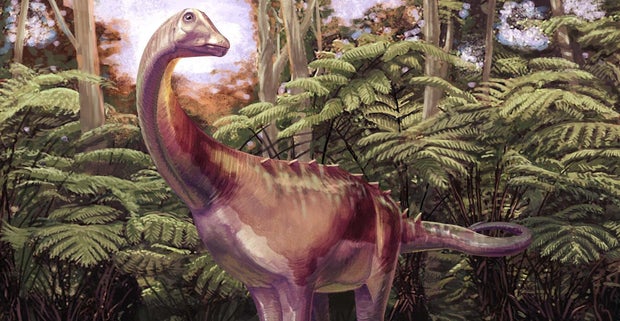
Scientists have unearthed a rare dinosaur fossil from Antarctica, which had been hidden away for decades in storage. The fossil, originating from the tail of a long-necked herbivorous dinosaur termed a titanosaur, remains unclassified at the species level. It was initially discovered in 1985 on James Ross Island by geologist Mike Thomson, during an expedition involving the British Antarctic Survey. Thomson’s primary aim was to map rock layers and gather marine reptile fossils for future geological dating.
Recorded simply as a large reptile, the find went unnoticed until paleontologist Mark Evans discovered it in the British Antarctic Survey’s collection. Upon examining the bone, Evans speculated it might be a dinosaur. He stated to BBC News, “It’s only when you start thinking ‘what’s in this drawer,’ that sometimes you come across something and you think, ‘Ah, this looks interesting.'” Further analysis and comparison with more complete dinosaur skeletons led to the confirmation of its origin. These findings were published in Acta Palaeontologica Polonica.
“This discovery represents only the second sauropod body fossil known from Antarctica, although it was the first dinosaur bone to be collected from the continent,” the study’s authors noted.
Finding dinosaur remains in Antarctica is rare due to its harsh ice-covered environment. However, millions of years ago, the region was lush with forests. Study co-author Paul Barrett from the Natural History Museum in London remarked that back then, Antarctica was a “much more hospitable place.” The identified titanosaur lived in these forests around 80 million years ago.
The discovered specimen, at approximately 23 feet in length, would be considered small for its group and possibly juvenile. The circumstances of its death remain unknown, but scientists propose its body might have floated from the coastline before settling on the sea floor, leading to fossilization in marine sediments.
Globally, over 100 species of titanosaurs have been cataloged. These dinosaurs, recognized for their long necks and counterbalancing tails, were quadrupedal plant-eaters capable of reaching tree canopies. The largest among them, measuring over 115 feet and weighing around 60 tons, highlight the diversity within this group.
Modern technological advances have enabled researchers to delve deep into fossil structures, unveiling intricate details of ancient life forms. Sadly, Mike Thomson passed away in 2020, prior to the fossil being identified as a dinosaur. Co-author Mark Evans noted, “If he were still with us, he would be delighted to know what this was.”
Leave a Reply