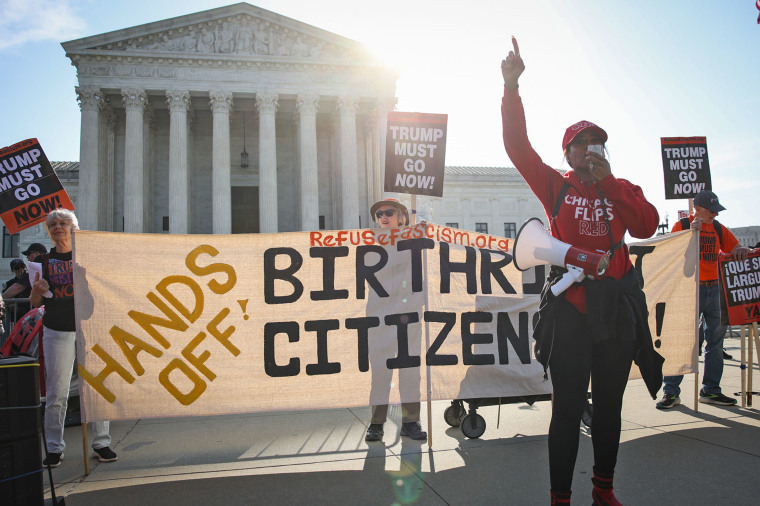
The Supreme Court halted President Donald Trump’s attempt to limit birthright citizenship for those born on U.S. soil. In a 6-3 decision, the court found the executive order Trump issued on January 20, 2025, unconstitutional. Five justices ruled it violated the 14th Amendment, which traditionally grants citizenship to nearly everyone born in the U.S. Justice Brett Kavanaugh disagreed on the constitutional violation but said the order breached federal law.
This decision marks Trump’s third recent loss in the Supreme Court, following rulings against his tariffs and an attempt to dismiss Lisa Cook from the Federal Reserve. Despite a 6-3 conservative majority composed of justices he appointed, the court has not always ruled in Trump’s favor.
Chief Justice John Roberts authored the majority opinion, stating that there was insufficient evidence for Trump’s reinterpretation of citizenship laws. “Citizenship then and now, was the right to have rights — to freely participate in our political community,” he said. The 14th Amendment was designed post-Civil War to guarantee rights to everyone, including former slaves. “We keep that promise today,” Roberts affirmed.
Conservative justices Clarence Thomas, Samuel Alito, and Neil Gorsuch dissented, supporting Trump’s view that his executive order aligned with the 14th Amendment. Trump aimed to restrict birthright citizenship to those with a U.S. citizen or permanent resident parent. This would exclude children of temporary visitors or those who entered the U.S. illegally.
Justice Thomas, in his dissent, argued that the 14th Amendment was initially intended for formerly enslaved Black individuals. He wrote, “Blacks were entitled to citizenship because they were Americans. They had no other homeland, owed no allegiance to any foreign power, and were subject to no other authority. The same could not be said for the children of foreign temporary visitors.”
The executive order never took effect, as lower courts swiftly blocked it after Trump signed it. Cecillia Wang, National Legal Director at the American Civil Liberties Union, noted, “The court’s decision reaffirms a fundamental American promise — if you are born here, you are a citizen. A president cannot change the Constitution by executive fiat.” For over a century, the 14th Amendment has been understood to apply broadly, with few exceptions like children of diplomats.
The Supreme Court confirmed the applicability of the 14th Amendment in 1898 in United States v. Wong Kim Ark, ruling that a man born in San Francisco to Chinese immigrant parents was a U.S. citizen. Trump’s order faced numerous legal challenges from liberal states and civil rights groups, all ruling against the administration. In December, the Supreme Court agreed to hear a case from New Hampshire involving the ACLU, representing individuals who would be affected by Trump’s executive action.
Leave a Reply