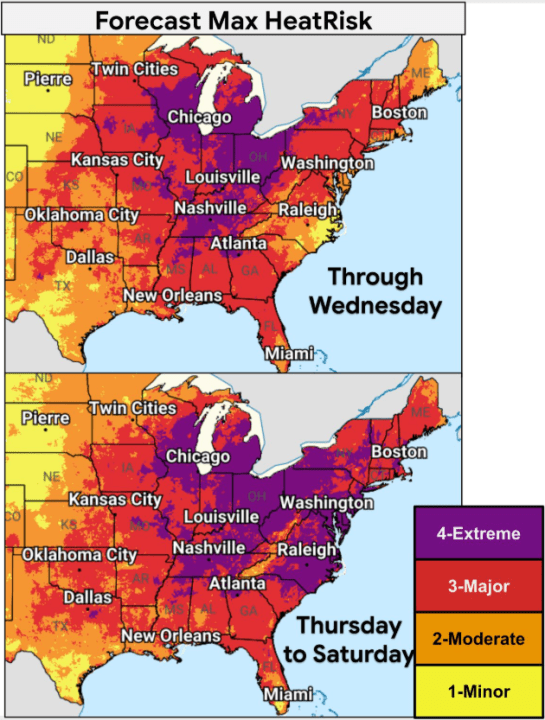
Communities across the central and eastern United States are currently facing a record-breaking heat wave. The extreme heat is becoming more hazardous as it combines with high humidity ahead of the Fourth of July celebrations. In several locations, the heat index, which includes humidity in its calculations, could rise between 105 and 115 degrees Fahrenheit, according to Nexstar Chief Meteorologist Brian James.
By Tuesday, cities in the Midwest and South, such as Chicago and Minneapolis, already registered heat indices surpassing 100°F. (Source: NWS)
According to forecasters, a stretch of high temperatures, with some reaching over 100°F, will affect areas in the lower Great Lakes, mid-Atlantic, and the Mississippi and Ohio River valleys. Meteorologist Bryan Putnam from the National Weather Service (NWS) indicated that some locations from the lower Great Lakes to New England may experience record highs later in the week.
Several major cities, which are hosting World Cup matches and events for America’s 250th anniversary, could report their highest temperatures this year. Among these are East Coast cities like New York, Philadelphia, Washington, and Baltimore, along with Midwest and Great Lakes cities such as Chicago, Indianapolis, St. Louis, and Detroit. Southern cities like Dallas, Little Rock, Arkansas, and Memphis, Tennessee, are also expected to experience high temperatures.
National Weather Service Predictions
The NWS has projected record-breaking temperatures for several cities. Here are some notable predictions:
- Wednesday: Binghamton, NY: 91°F (Previous: 90°F in 2018), Cleveland, OH: 97°F (Previous: 95°F in 2002)
- Thursday: Albany, NY: 99°F (Previous: 98°F in 1966), Boston, MA: 101°F (Previous: 98°F in 1963)
- Friday: Westfield/Springfield, MA: 100°F (Previous: 97°F in 2002), Washington, D.C.: 104°F (Previous: 101°F in 1966)
- Saturday: Baltimore, MD: 101°F (Previous: 100°F in 2002), Richmond, VA: 102°F (Previous: 100°F in 2002)
Understanding the Heat Dome
A significant factor in this heat event is a “heat dome,” which is a high-pressure system that causes air to sink, trapping heat. The NOAA explains that without lift, there is minimal chance for rain, as convection and cloud formation are reduced. As a result, heat builds up at the surface, leading to the heat wave.
The high-pressure system also deflects storms, reducing the possibility of summer thunderstorms that could cool down the area. The NWS advises checking on vulnerable people, including young children, older adults, those with chronic medical conditions, and pregnant women.
Experts emphasize the importance of staying hydrated, seeking shade, limiting outdoor activities, and never leaving children or animals in unattended vehicles.
Leave a Reply