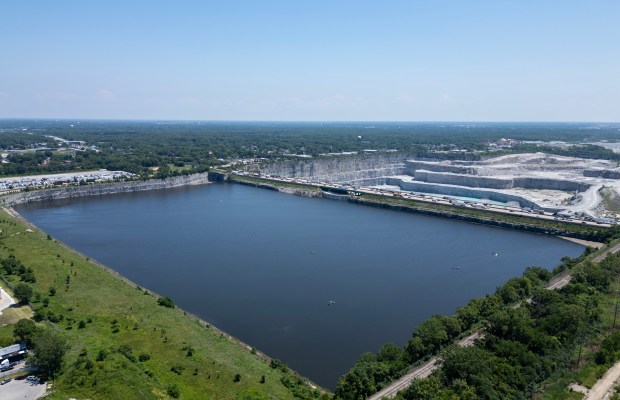
The Thornton Composite Reservoir has reached a record 94% capacity after heavy rains, causing concern among south suburban residents about potential flooding and unpleasant sewage odors. The reservoir, operational since 2015, saw its highest previous capacity in 2019 at 54.5%, according to the Metropolitan Water Reclamation District of Greater Chicago.
By 10:15 a.m. on Tuesday, the water level had slightly dropped to 93%, equating to 7.3 billion gallons, as reported on the district’s website. With billions of gallons of sewer water exposed, residents are enduring strong odors. Thornton Village Clerk Nikki Kitakis describes the smell as “pretty horrific,” stating that the issue worsens as the reservoir fills.
Despite efforts by the water reclamation district to alleviate the stink, Kitakis notes that addressing a “quarry full of disgustingness” presents significant challenges. The district announced on social media that they are “working around the clock” to manage water levels at the Thornton and McCook reservoirs, the latter serving central Chicago.
The Thornton reservoir draws water from 14 communities, including Chicago’s Far South Side, impacting 556,000 people. It’s the largest combined sewer reservoir globally, with heightened risk of flooding if it reaches maximum capacity, the district cautioned. At Dolton’s Village Board meeting, residents recounted flooding experiences.
Mayor Jason House sympathized with those affected, stressing that complete infrastructure upgrades would cost around $50 million. Meanwhile, Matt Stacy, Dolton’s public works superintendent, kept in close contact with the water reclamation district, worried as the reservoir neared capacity.
The potential for rain later this week aggravates concerns, with forecasts indicating possible showers on Thursday and Friday, and lesser chances on Saturday, as per the National Weather Service. Recent storms resulted in Flossmoor recording 6.37 inches of rain.
Interstate 80/294 adjoins the Thornton Quarry and Deep Tunnel system reservoir, which nearly reached full capacity due to a rainy June and early July. To manage the reservoir, water flows by gravity to the Calumet Water Reclamation Plant, located 5 miles north. At the plant, it is pumped up approximately 300 feet for treatment before disposal into the Little Calumet River.
The Thornton reservoir’s total storage capacity is 7.9 billion gallons. Present levels indicate room for an additional 600 million gallons, as explained by Allison Fore, public and intergovernmental affairs officer for the district. Specifics on the drainage timeframe remain undisclosed.
Leave a Reply