By: Updated on July 24, 2026, at 8:44 PM EDT
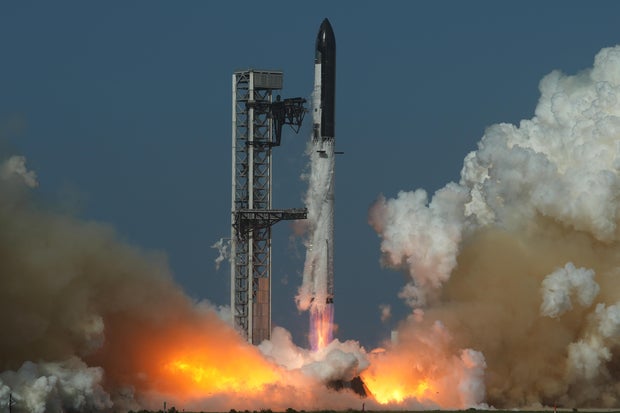
SpaceX successfully launched its thirteenth Super Heavy-Starship rocket. The massive booster achieved an on-target but “hard” splashdown off the Texas Gulf Coast, while the Starship upper stage completed a sub-orbital hop to the Indian Ocean.
This 397-foot-tall two-stage rocket, powered by 33 methane-fueled Raptor engines, lifted off from SpaceX’s “Starbase” in Texas at 5:51 p.m. EDT. The launch provided a spectacular display for residents and tourists as it ascended on the strength of approximately 16 million pounds of thrust.
A previous attempt on July 16 was aborted at the last second due to issues with four Raptor engines. These were resolved, and after a 24-hour delay for better weather, the launch succeeded. All 33 first-stage engines fired up normally, leading to a clear ascent.
This was the second test of a third-generation Super Heavy-Starship. Lessons learned from a “V3” rocket flight in May, where the booster missed its target and the Starship’s engine shut down early, guided improvements. This time, the booster appeared to meet expectations, but fewer engines restarted during descent, resulting in a harder splashdown than intended.
SpaceX uses splashdowns in the Gulf for these early flights as a safety measure. A camera on the booster captured the descent into the Gulf.
Meanwhile, the Starship upper stage operated smoothly with all six Raptor engines. On its sub-orbital trajectory, the Starship deployed 20 third-generation Starlink satellites. This demonstration tested its Pez-like payload dispenser, which released satellites one at a time.
Six satellites were equipped with cameras to assess the Starship’s heat shield and overall condition. Video footage from these cameras aids engineers in determining the spacecraft’s health before re-entry.
Starship reignited one Raptor engine in space to show its ability to restart, crucial for future lunar missions. After re-entry, it flipped upright and settled in a controlled splashdown northwest of Australia, completing its flight an hour and five minutes after launch.
The deployed Starlink satellites were expected to burn up upon re-entry, as described by SpaceX.
This mission had significant implications for NASA, which needs a version of the Starship as a lunar lander for the Artemis program. For the first time, Starship remained intact after splashdown, with operational cameras on board.
SpaceX aims to launch up to 15 Super Heavy-Starship tankers to refuel the lander bound for the moon. Upon refueling, the Starship will rendezvous with astronauts in an Orion capsule built by Lockheed Martin. This lunar lander will transport two crew members to the moon’s surface as early as 2028. NASA plans to lower astronauts to the surface with an external elevator.
NASA’s timeline requires SpaceX to increase Super Heavy-Starship testing to ensure safe and frequent launches. As of yet, this lunar lander variant and no Starship has successfully entered Earth orbit. Many NASA veterans critique the mission’s complexity and the frequency of flights needed.
The Government Accountability Office highlighted SpaceX’s challenges in its rocket development. The top concern includes the cryogenic fuel management technologies needed for propellant transfers in low-Earth orbit. This transfer is crucial before docking with Orion in lunar orbit.
Additionally, the GAO report noted that SpaceX is over a year behind its original timeline for key phases. These phases include the critical design review and other crucial demonstrations.
Nasa includes Blue Origin, owned by Jeff Bezos, as part of its contingency plans for lunar missions. Blue Origin is developing another lander for NASA, requiring in-space refueling similar to SpaceX. However, challenges persist, highlighted by the explosion of Blue Origin’s New Glenn rocket during testing.
Despite this setback, NASA proceeds with Artemis preparations, including interim test flights in low-Earth orbit. An Orion capsule will carry astronauts to test rendezvous and docking procedures critical for future moon landings. These procedures involve docking with a Blue Origin lander while using a modified Starship for demonstration purposes, albeit without deploying inside.
Leave a Reply