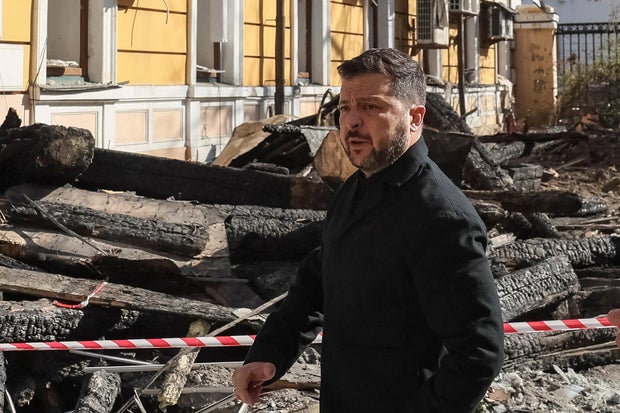
Ukraine’s President Volodymyr Zelenskyy stated on Monday that Russia is not observing the energy ceasefire proposed by President Trump. Hours after Trump’s announcement, Russia reportedly attacked a power plant in eastern Ukraine, followed by assaults on six more energy facilities by Monday afternoon.
Zelenskyy declared Ukraine’s readiness to adhere to the ceasefire, awaiting Russia’s reciprocal actions. He wrote on X, highlighting the absence of any Russian compliance with the American President’s outlined conditions. When questioned on Russia’s possible breach of the ceasefire, Trump responded, “I’m not sure about that, and we’ll take a look. But all I know is that Zelenskyy and Putin have to get together and end that ridiculous war.” He mentioned violations from both sides.
Additionally, Trump expressed his belief that President Putin is more inclined to negotiate a deal than Zelenskyy. Over the past year, Trump has tried several times to mediate agreements to halt energy infrastructure attacks between Russia and Ukraine, all of which failed to be sustained.
In January, Trump claimed a temporary agreement with Putin, only for Russia to strike Kyiv soon after. A September proposal also faltered with both parties continuing attacks. Zelenskyy, in an interview with CBS News post-September proposal, expressed willingness for a ceasefire but doubted Russia’s commitment to such arrangements.
One of the challenges is that Russian attacks on Ukraine’s energy infrastructure have a larger impact compared to Ukrainian strikes. While Ukraine targets Russian oil and gas infrastructure to weaken Russia’s war finances, this has only brought Russian oil refining to a 20-year low without significant economic collapse.
According to the International Energy Agency, diesel production in Russia dropped by 30% in 2026. Alexander Kolyandr, director for Europe at Eurasia Group, remarked that although Ukraine’s attacks pressure Russia’s economy, they are not leading to economic collapse. Russia’s larger economy and military capacity, featuring drones and missiles, allow it to exert more significant pressure on Ukraine.
Ukraine, with a smaller economy, faces higher relative impacts from Russian actions. As winter arrives, Russia continues targeting Ukraine’s power grid, causing power outages. Last winter, amidst repeated power cuts, Trump asked Putin to halt energy strikes on Ukraine. Recently, Trump shifted focus to pressuring Ukraine regarding high global energy prices linked to the Russia-Ukraine conflict.
Trump announced a recent agreement permitting Russia to sell some diesel to U.S. and international markets, diverging from prior efforts to block Russian petroleum sales. A European and Ukrainian official reported that the Trump administration threatened to halt intelligence sharing and stop European allies from purchasing U.S. weapons for Ukraine unless Ukraine ceased its deep strikes on Russian energy targets.
The Ukrainian government, taking these threats seriously, depends on U.S. intelligence for crucial information on Russian missile launches. Furthermore, the PURL procurement system is vital for Ukraine to acquire Patriot air defense missiles, which are limited in supply. The Financial Times initially reported these threats, and CBS News has reached out to the White House for comments.
Zelenskyy emphasized that progress towards an energy ceasefire relies on the U.S. administration pushing more pressure on Russia. “A lot depends on America’s position for de-escalation to actually succeed,” he posted on X, stressing the need for pressure on Russia.
Leave a Reply