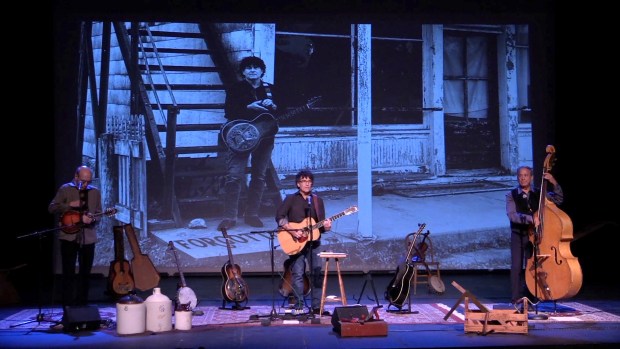
Chris Vallillo, a seasoned musician, will soon perform at Steppenwolf Theatre’s intimate 1700 Theater space, which seats 80 people. Joining him are noted musicians Don Stiernberg on mandolin and Marc Edelstein on bass. Their music will be complemented by Tim Schroll’s striking black-and-white photography.
The performance, entitled “Forgottonia,” is likened by Vallillo to “Bruce Springsteen meets ‘Prairie Home Companion.'” Speaking on the phone while traveling from Michigan to Downers Grove, Vallillo, a constant traveler, shared insights into his journey. Born in Hammond, Indiana, his family’s frequent moves were dictated by his father’s job as a civil engineer. He began exploring music in New Castle, Pennsylvania, driven initially by the appeal of playing the guitar. He recalls, “I always felt drawn to the guitar,” eventually convincing his parents to let him learn in the sixth grade.
Vallillo’s passion for music grew alongside his studies at Beloit College, where he earned a degree in archaeology. Although he considered a Ph.D., the desire to delve into archaeology fieldwork and his growing musical passion led him away from academia. Vallillo’s commitment to music’s storytelling nature became a central focus, as recognized by Arthur Wood of FolkWax magazine, who praised his guitar playing as “a true aural delight.” His production of “Abraham Lincoln in Song” in 2007 received endorsement from the Lincoln Bicentennial Commission, and his 2015 release, “Oh Freedom! Songs of the Civil Rights Movement,” emphasized music’s power to inspire and unite during tumultuous times.
“Forgottonia,” a concept shaped by an archaeological field trip in 1976, explores historical and cultural narratives. The term “Forgottonia” emerged in the late 1960s, inspired by a group from 16 western Illinois counties who aimed to draw attention to neglected regional transportation needs. The group’s imaginative political theatrics called for secession, war declaration, and surrendered aid requests, resonating widely and leading to increased investments in the area.
As Vallillo explored these communities in 1976, he was captivated by their history and music. His eventual album received acclaim, gaining airplay on programs like “The Midnight Special” on WFMT-FM 98.7. Journalist Marilyn Rea Beyer praised it as “a memorable set,” and another critic called it “a 12-tune marvel.” Vallillo’s performance, seen in venues such as Western Illinois University and the Orpheum Theatre, has been described as a “multi-media love letter” to rural America.
Vallillo has long aspired to present this work in a major city. Residing in Macomb, he and his wife Dorie, a former NPR radio station manager, raised their daughter Maggie. After multiple attempts to engage Chicago theaters, Vallillo connected with Steppenwolf, bringing the “Forgottonia” show to a broader audience.
His upcoming Steppenwolf performance will be part of the LookOut Series at the 1700 Theater. Vallillo, anticipating the urban audience’s reaction, remains optimistic. His belief in folk music as a dynamic form that captures everyday life imbues his work with continued relevance.
Folk music is not a static thing at all. It is a living, breathing thing. It is music that evolves, reflecting everyday people’s lives, concerns, struggles.
For those interested in attending, “Forgottonia” is scheduled for 7:30 p.m. on Aug. 8 and 3 p.m. on Aug. 9 at Steppenwolf’s 1700 Theater, located at 1700 N. Halsted St. Tickets and additional details are available at www.steppenwolf.org.
Leave a Reply