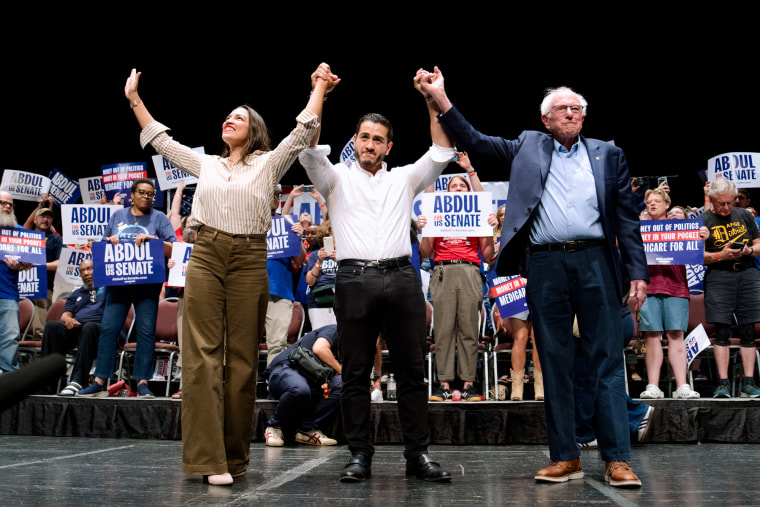
Abdul El-Sayed has achieved victory in Michigan’s Democratic Senate primary, edging out Rep. Haley Stevens, as projected by NBC News. This win is a significant gain for the progressive left in the Midwest during this midterm election season. Despite facing nearly $65 million in external funding and an establishment favoring Stevens, El-Sayed emerged triumphant. Gov. Gretchen Whitmer, in an effort to halt El-Sayed’s rise, endorsed Stevens late in the campaign.
El-Sayed, previously a public health official, will compete against former Rep. Mike Rogers, who won the Republican nomination unopposed. The upcoming race in November is poised to be highly competitive, with potential implications for Senate control. The victor will succeed Sen. Gary Peters, who declined to seek another term and had endorsed Stevens in the primary. Currently, Republicans hold 53 Senate seats, while Democrats aim to flip four seats to secure a majority. Strategically, Democrats are not only targeting red states but also defending seats in battleground states like Georgia and Michigan. President Donald Trump, whose support propelled Rogers to the GOP nomination, had victories in Michigan in the 2016 and 2024 elections, but lost to Joe Biden in 2020.
Rogers and national Republicans perceive El-Sayed as a more vulnerable opponent compared to Stevens. The National Republican Senatorial Committee even released a digital ad to highlight El-Sayed’s progressive views and his endorsement from Sen. Bernie Sanders. This move was interpreted by many as an attempt to support El-Sayed in the general election.
Prominent figures like Sanders and Rep. Alexandria Ocasio-Cortez campaigned vigorously for El-Sayed, whose advocacy for “Medicare for All,” opposition to political finance, and critique of Stevens for her stance on aid to Israel were key campaign themes. This primary served as a test for an insurgent populist movement that had already succeeded in other states like New York and Colorado, assessing its potential influence in a swing state like Michigan.
El-Sayed, similar to other left-leaning Democrats, accused Israel of committing genocide in Gaza, resonating with Michigan’s substantial Muslim and Arab American communities. He also consistently criticized Stevens for accepting corporate PAC money and the substantial financial backing she received, including over $30 million from a group associated with AIPAC, the influential pro-Israel organization.
Despite Stevens and her allies’ significant spending on advertisements, estimated at nine times more than El-Sayed’s campaign according to AdImpact, El-Sayed challenged their reliance on money in a debate, asserting, “If you need a $60 million crutch, you probably can’t be elected on your own terms.” Stevens, a four-term congresswoman, was closely aligned with the Democratic establishment, gaining support from prominent figures like Whitmer and Senate Minority Leader Chuck Schumer. El-Sayed, gaining backing from national left-wing figures and influential local entities like the United Auto Workers, forged a different path.
The primary intensified after state Sen. Mallory McMorrow withdrew, having initially tried to attract moderate and progressive voters as a middle-ground candidate. McMorrow supported El-Sayed, seeking unity within the party, highlighting, “This was a brutal primary, but the differences here pale in comparison to what’s at stake in November.”
Stevens, during the campaign, often criticized El-Sayed for concentrating too much on national rather than state issues. Whitmer’s late endorsement supported Stevens’ claims. A leaked donor call, where El-Sayed hinted his victory might inspire challengers to figures like Sen. John Fetterman, further fueled the discourse, as some interpreted his “ogre on a pike” remark as targeting Stevens.
Stevens faced criticism related to her Midwest accent and style but leveraged it to emphasize her relatability, stating, “I sound like the people who need help.” Conversely, El-Sayed remained consistent in his core message, challenging corporate influence and advocating for politics by and for the people.
Leave a Reply