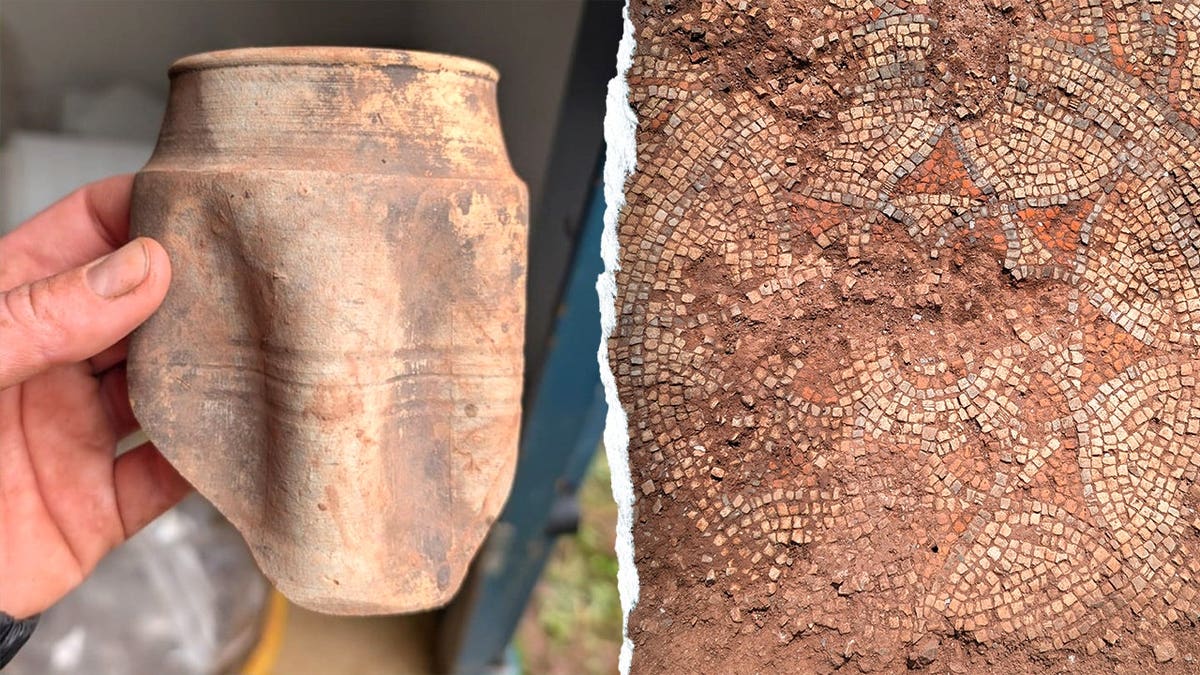
Recent archaeological efforts in the United Kingdom have led to the discovery of a sizeable ancient Roman villa, dating back over 1,600 years. This fourth-century villa was found situated on farmland located between the villages of Halberton and Sampford Peverell in Devon.
The excavation was conducted by the Saving Halberton’s Ancient Roman Environment (SHARE) project, a collaboration between the University of Exeter and Cotswold Archaeology, as reported by news agency SWNS.
Rare artifacts, including a pagan masterpiece, reveal extensive Roman influence near Devon.
A standout feature of this excavation is an intricate Roman mosaic composed of thousands of small stone cubes arranged into a floral design. As Bill Horner, county archaeologist and historic environment manager at Devon County Council, noted, “The polychrome mosaic is the most westerly example to have been found in a villa in Roman Britain.”
The relics uncovered show that even the distant areas of the Roman province in Britain were aligned with Roman civilization and affluence. Photographs released show the mosaic and various ancient pottery and artifacts.
Additional structures discovered include two stone buildings: one likely served as a bathhouse and the other possibly had an agricultural use. These discoveries add to the understanding of the lifestyle of a wealthy Roman family that likely once resided at this villa.
Susan Greaney, professor of archaeology at the University of Exeter and project leader, reflected on the unexpected nature of their discoveries. She remarked, “We did not anticipate finding such an elaborate bathhouse.” The villa site, first identified in 2004 by local metal detectorist John Hill, is considered crucial for understanding Roman influences in Devon.
Currently, there are efforts to carefully relocate the mosaic to the Tiverton Museum of Mid-Devon Life.
This find joins the roster of significant Roman discoveries throughout England in recent years. For instance, last summer marked the unearthing of a vast 2,000-year-old Roman settlement in the Cotswolds following another chance discovery by an amateur metal detectorist.
Leave a Reply