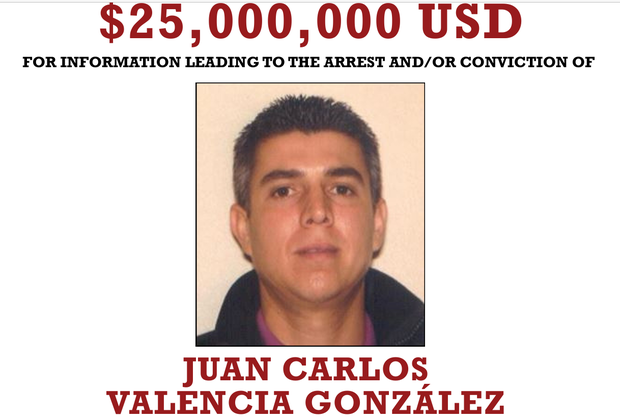
The U.S. State Department has announced an increased reward of $25 million for information leading to the capture of Juan Carlos González, also known as “Pelón.” This move aims to escalate pressure on him as he emerges as a key figure in Mexico’s strongest cartel.
Previously set at $5 million, the reward increase highlights the urgency in capturing González, who is identified as the current head of the Jalisco New Generation Cartel (CJNG). The Trump administration has focused on combating CJNG by offering a combined $102 million in rewards for its leaders. Additionally, visa restrictions have been imposed on the family and business associates of cartel members. The intention is to undermine and dismantle the cartel’s leadership structure.
In February, CJNG suffered a significant setback when its leader, Nemesio Rubén Oseguera Cervantes, or “El Mencho,” was killed by the Mexican military. The U.S. supported this operation with intelligence, which subsequently intensified violence in Jalisco state. González, described as Oseguera Cervantes’s stepson, holds dual nationality, being both a Mexican and U.S. citizen, and has reportedly assumed control of the cartel. His activities range from drug trafficking to avocado production.
Born in Santa Ana, California, on September 12, 1984, González is not the only target. The State Department also announced rewards for other key figures within the cartel. These include up to $15 million for Audias Flores Silva, “El Jardinero,” and $15 million each for Gonzalo Mendoza Gaytán, “Sapo,” and Julio Alberto Castillo Rodríguez, “Chorro.” A reward of up to $10 million is set for Ricardo Ruiz Velasco, “Tripa,” Julio César Montero Pinzón, “El Tarjetas,” and Carlos Andrés Rivera Varela, “La Firma.” Griselda Margarita Arredondo Pinzón has a reward offer of $2 million.
The Trump administration has also taken economic measures against the cartel. Sanctions announced recently affected 50 individuals and companies linked to CJNG, including González. These sanctions aim to freeze assets and block financial dealings in the U.S.
CJNG stands as Mexico’s largest cartel, operating in 21 out of 32 Mexican states, with its influence extending into the United States and beyond. The U.S. is actively working to dismantle CJNG, a point emphasized by Secretary of State Marco Rubio. He reiterated the administration’s commitment to targeting and disbanding the cartel.
Efforts have included urging Mexican President Claudia Sheinbaum to intensify actions against these criminal groups. Even the possibility of military involvement was mentioned as a necessary step by the U.S. administration.
In addition, the U.S. Treasury’s Office of Foreign Assets Control recently alerted banks to cartel-related activities. This includes sanctioning individuals and companies intertwined with a fuel theft operation that evaded Mexican taxes, reportedly generating substantial revenue for CJNG.
Leave a Reply