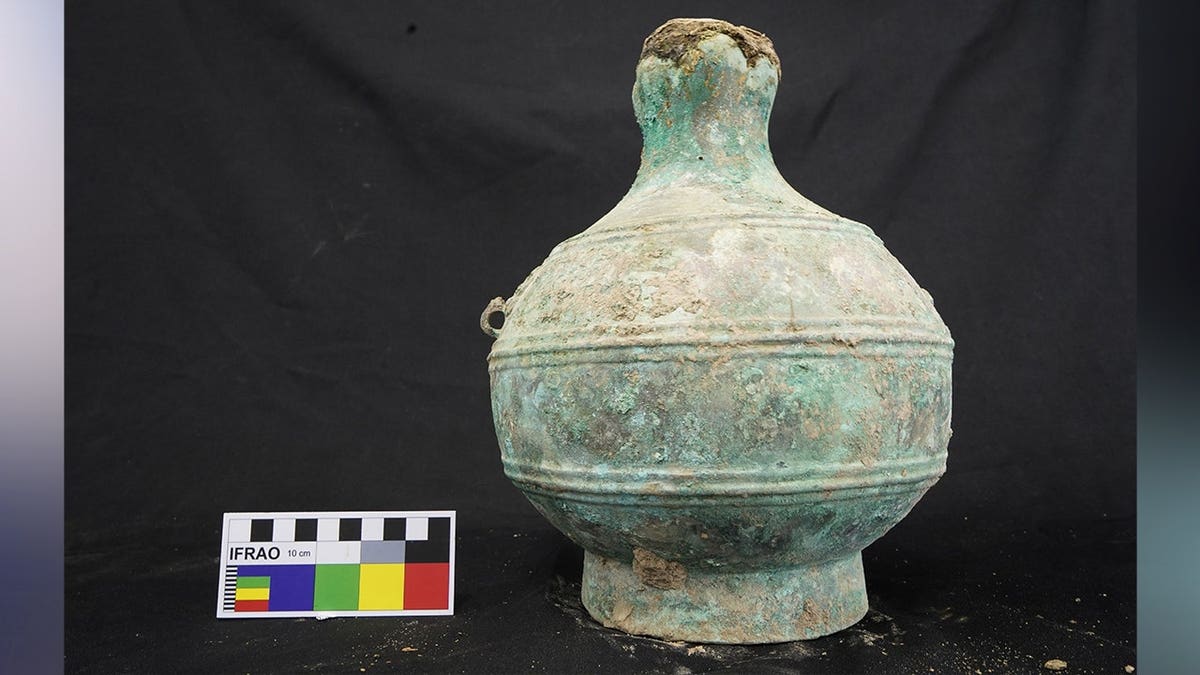
Researchers in China have recently made a remarkable discovery. They found a 2,200-year-old alcoholic drink buried in a Qin tomb at the Shanjiabao cemetery in China’s Ningxia Hui Autonomous Region. This alcohol, sealed in a bronze vessel, was described in the Journal of Archaeological Science: Reports in June. The tomb dates back to the Warring States period (475-221 B.C.), a time characterized by rival kingdoms before China’s unification.
Unlike other findings where only residues of ancient drinks were found, this time the bottle contained 3.74 liters of preserved liquid. Ruru Chen from Northwest University’s School of Cultural Heritage in Xi’an noted the large volume and exceptional preservation of the liquid.
The sample dates to the Warring States period, making it an extremely rare preservation case.
The alcohol lacked any noticeable odor and had a clear, light blue-green color with some sediment. The beverage was stored in a bronze bottle with a “garlic-shaped mouth,” a style typical of the Qin people for storing alcoholic drinks.
Researchers employed organic chemistry, metabolomics, starch grain analysis, and yeast remains to determine the type of beverage. The analysis showed that broomcorn millet was the primary ingredient, with some wheat and/or barley. The drink resembled a non-distilled beverage made from millet or a mix with wheat/barley.
High concentrations of lactic and oxalic acids and other compounds confirmed the cereal-based nature of the beverage. Chen clarified that it did not resemble distilled spirits.
The distinctive bronze vessel, the sealing method, and the burial conditions might have contributed to the liquid’s preservation over two millennia. Researchers aim to explore more about how these factors ensured the drink’s survival.
This discovery could spark interest in ancient Chinese alcoholic beverages and traditional brewing techniques. A prior discovery at a Bronze Age cemetery in northwestern China found microscopic residues of fermented beverages. These studies continue to provide insights into ancient brewing practices involving millet, rice, wheat, and barley.
Leave a Reply