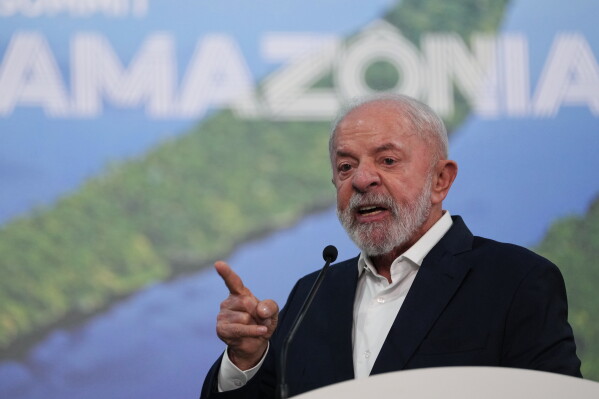
Brazil’s Supreme Court will review several critical cases that may alter protections for the Amazon rainforest and Indigenous communities. These cases involve disputes over Indigenous land rights, environmental safeguards, and infrastructure projects. A conservative Congress recently approved measures that environmentalists claim infringe on constitutional rights.
President Luiz Inácio Lula da Silva, with an environmentally-focused agenda, vetoed some measures, but Congress has overridden these objections. Thus, the Supreme Court is seen by environmental advocates as the last hope to stop the erosion of environmental protections.
Despite Lula’s achievements in reducing deforestation, the administration struggles in Congress, where agribusiness interests heavily influence. Agribusiness has pushed for measures weakening environmental protections, making the Supreme Court a significant check against these efforts.
Brazil, the largest soybean and beef producer, exports significant portions of these commodities, particularly to China. The expansion of agriculture, especially cattle ranching and soybean production, drives deforestation in the Amazon. Agribusiness groups oppose illegal deforestation, citing increased productivity with reduced forest clearing.
The Amazon forest has a vital role in climate regulation, storing carbon that could worsen global warming if released.
The Supreme Court recently reviewed a pivotal case concerning Indigenous rights, rejecting the ‘time limit’ thesis. This theory would have limited Indigenous land claims to areas occupied when the 1988 Constitution took effect. Indigenous groups argue this ignores historical expulsions and displacements.
The court will address compensation rules and deadlines for demarcating Indigenous lands. Some proposals may hinder future demarcations by imposing administrative hurdles and expanding compensation rights.
The Kawahiva people, isolated in the Amazon, are among those affected. They are nomadic hunter-gatherers confirmed to reside in Mato Grosso since 1999.
Two other important case sets are up for review. These involve state laws affecting the soy moratorium and a new environmental license law. The soy moratorium, which helped reduce deforestation by barring soy grown on cleared land, ended after certain state bills revoked tax benefits. Justice Flávio Dino issued an injunction halting these bills, with the full court set to review his decision.
The court will also examine a challenge to the environmental licensing law that streamlines permits for impactful projects. Environmentalists label parts of this law unconstitutional, especially self-licensing for moderate impact projects.
The environment ministry supports the soy moratorium’s success in reducing deforestation while expanding production. They sought to veto problematic provisions of the new licensing law, emphasizing the need for a robust national environmental licensing system.
The system should balance infrastructure investment with tackling climate change and biodiversity loss.
Leave a Reply