The trailer for Sony Pictures’ film “The Social Reckoning” introduces a star-studded cast including Jeremy Strong, Jeremy Allen White, and Mikey Madison. Directed and written by Aaron Sorkin, the movie attempts to follow up on “The Social Network,” a film that was critically acclaimed for its portrayal of Facebook’s origins.
In the Trump 2.0 era, tech giants, once favored by the liberal left, face criticism for their perceived alignments with former President Donald Trump post-2024 election. This includes figures like Elon Musk, Jeff Bezos, and in this specific context, Mark Zuckerberg. Zuckerberg, co-founder of Facebook, was previously depicted in the 2010 film “The Social Network,” which, directed by David Fincher and written by Sorkin, explored the creation of Facebook and the lawsuits that followed.
Sorkin achieved an Oscar for Best Adapted Screenplay with the film, and both Fincher and Jesse Eisenberg, who played Zuckerberg, received nominations for their roles. The film successfully captured the complexity of the digital age. However, the sequel, “The Social Reckoning,” seeks to expand on this but struggles to achieve the same impact.
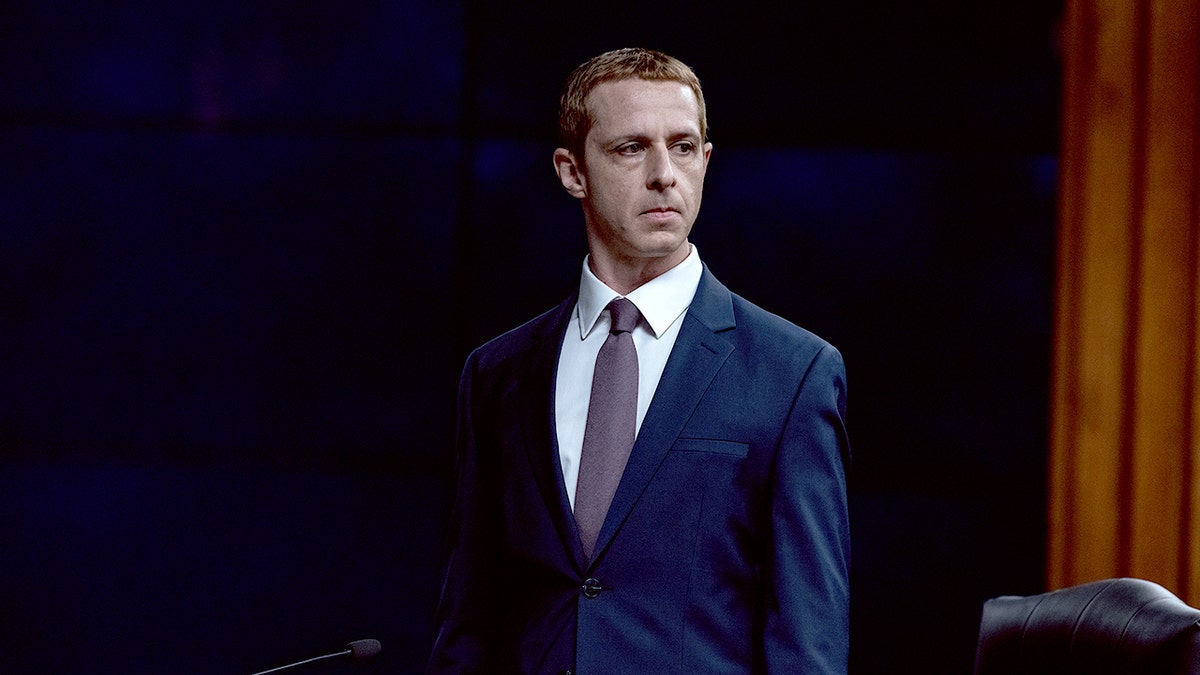
Jeremy Strong takes on the role of Mark Zuckerberg in “The Social Reckoning.”
This new installment does not feature Fincher or Eisenberg, leaving Sorkin both writing and directing, with Jeremy Strong portraying Zuckerberg. The sequel examines significant reports from the Wall Street Journal known as “The Facebook Files,” led by investigative reporter Jeff Horowitz and whistleblower Frances Haugen.
The reports revealed troubling findings about Facebook’s algorithms pushing users towards hate groups and the negative impact of Instagram on young girls’ mental health. While many agree that social media can be detrimental, these issues have tainted Facebook’s reputation and perhaps justify cinematic exploration.
Sorkin’s portrayal centers blame on Facebook for advancing right-wing radicalization while dismissing left-wing extremism. The film illustrates Haugen, a former Facebook data scientist, as haunted by a friend transformed by the platform’s influence. It accuses Facebook of spreading conspiracy theories and misinformation, particularly surrounding the January 6 events.
Sorkin’s narrative has Zuckerberg and his team in a dramatic scene watching news of the Capitol riot, emphasizing Facebook’s responsibility. As pressure mounts, Zuckerberg ultimately bans Trump from the platform, reinforcing Haugen’s portrayal that Facebook induces racism.
The absence of acknowledgment for far-left radicalization or the Black Lives Matter protests is noted. Also, COVID-19 lockdowns, which contributed to societal unease, receive no critique from Sorkin regarding governmental decisions.
The film explores Zuckerberg’s views on free speech, depicting him as a profit-driven figure at society’s expense.
In the film, Zuckerberg talks with a former investor, arguing that Facebook is a public square where users manage their content consumption. This philosophically aligns with free speech proponents until Zuckerberg concedes by banning Trump.
“The Social Reckoning” aims to be the “All the President’s Men” for social media but lacks emotional weight, catering predominantly to a liberal audience. The film’s dialogue appears excessively intellectual, reminiscent of Sorkin’s television work on “The West Wing,” which can seem unnatural in this context.
Jeremy Strong’s portrayal of Zuckerberg, while dedicated, lacks the resemblance Eisenberg achieved. Fincher’s absence leaves Sorkin with a less cohesive artistic direction despite the assistance of admirers like cinematographer Jeff Cronenweth and composer Alexandre Desplat.
Sorkin, a renowned screenwriter, struggles to provide a consistent directing voice. Compared to “The Social Network,” this follow-up feels fragmented and overly self-assured, failing to captivate audiences as effectively.
The film presents itself as a journalist drama but mainly targets a select audience, critiquing social media with a biased lens.
“The Social Reckoning” is rated R for language and runs for 1 hour and 52 minutes, currently available in theaters. It functions more as a political statement than entertainment, instructing rather than engaging viewers. For those seeking unbiased narratives, this film might be less appealing.
Leave a Reply