Growing up in Jaffa, attending church with my father, the cantor of our Greek Orthodox church, framed my experience as part of a Middle Eastern Christian community. As a boy, I joined the Christian Scouts, later leading the movement and marching band, which was a community pride source, participating in festivals like Christmas and Easter.
In our perfectly normal community, Muslims and Jews were our neighbors. We learned, worked, and lived together, establishing a harmonious coexistence. Being Christian, Arab, and Israeli offered a sense of rootedness, safety, and happiness, prompting me to often question the alarming descriptions I sometimes encounter about Israel’s current state.
The War on America’s Judeo-Christian Roots Threatens Everything We Share
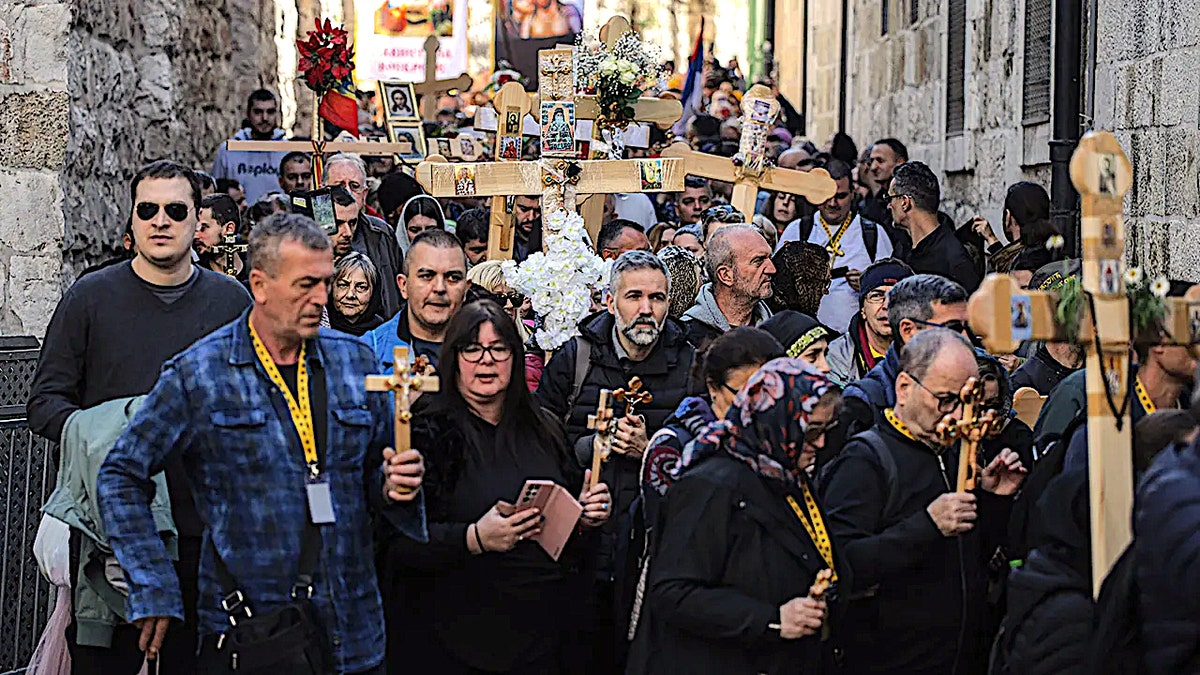
Orthodox Christians in Jerusalem carry wooden crosses during the Orthodox Good Friday procession, reflecting traditions rooted in Christian history. Contrarily, alarming narratives surface, portraying Christians living under siege in Israel, where growing Jewish hostility reportedly makes Christian life untenable. Disturbing incidents occur, with radicals spitting at clergy and vandalizing property, which Israel should unequivocally address through law enforcement and education.
But do these extremists define Israel? If yes, we must reconsider descriptions of several Western democracies. In 2025, for instance, the Anti-Defamation League recorded 6,274 antisemitic incidents in the U.S., a significant number, yet it doesn’t label America as antisemitic. Likewise, Spain saw a 23.6% rise in hate incidents. Extremism pervades democracies but does it represent society’s core?
Examining Christian presence, Christians are thriving in Israel. In 1950, approximately 34,000 Christians lived in Israel. Today, their numbers are around 184,000, continuously growing. Christian integration is visible in everyday life, exemplified by Justice Salim Joubran, an Arab Christian Supreme Court justice who participated in sending former Israeli president Moshe Katsav to prison. His ethnicity or religion was never considered an issue.
Christians in Israel are prominent professionals, including physicians, academics, soldiers, and diplomats. I am one, serving as Israel’s special envoy to the Christian world, a position aimed at strengthening global Christian relations. Additional significant steps include recognizing Aramean nationality and investing in Christianity’s history in places like Bethsaida on the Sea of Galilee.
Looking beyond Israel’s borders, Lebanese polling shows strong support for peace with Israel among Christian communities, possibly reflecting changing regional perspectives amid historical conflicts. Such developments reiterate that Middle Eastern Christians possess shared survival interests.
Israel confronts a crucial need for stronger enforcement and louder leadership against extremism. Education must improve. Yet, extremists should not define entire nations or people.
In the Middle Eastern context, the pivotal question remains: where will Christians continue thriving fifty years from now? Ideally, their future should include places deeply rooted in historical presence like Jaffa, Jerusalem, and Nazareth.
Christians persist not merely as artifacts or victims in their homeland but actively engage in worship, family life, government critique, and nation-building.
In closing, Israel harbors extremists deserving condemnation. But allowing them to solely characterize Israel distorts reality, deserving further scrutiny regarding motivations behind such narratives.
Ambassador George Deek, the author, is a seasoned diplomat, serving as Israel’s ambassador to Azerbaijan and the first Special Envoy to the Christian world, highlighting his lifelong involvement with Jaffa’s Arab Christian community.
Leave a Reply