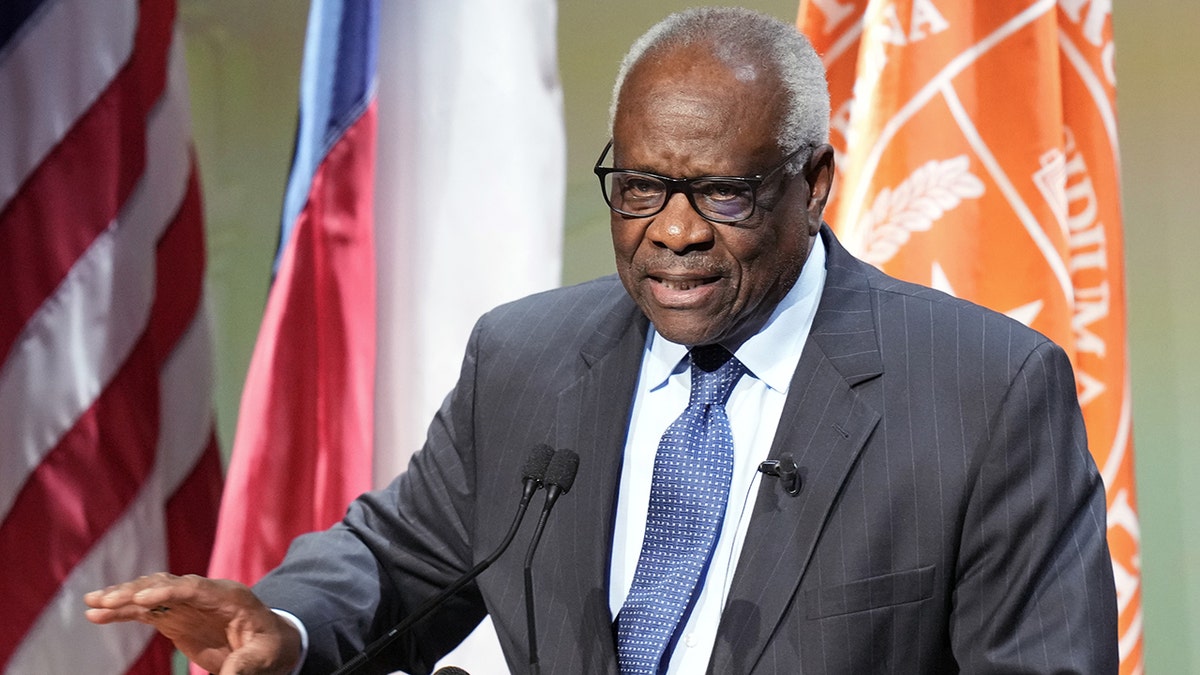
Supreme Court Justice Clarence Thomas spoke about how his views on race and politics have led some critics to question his Blackness. During a conversation at the Hoover Institution with Peter Robinson, Thomas expressed incredulity at this questioning, saying, “I mean, how stupid is that? Look at me,” while pointing to himself. He found the notion of ‘Blackness as a state of mind’ particularly absurd.
The discussion included reflections on the role of Black Americans in politics and how Thomas Sowell, a Black conservative economist, influenced Thomas’s thinking. Justice Thomas credited Sowell with giving him the confidence to challenge prevailing expectations about the political views that Black Americans are expected to hold.
“Liberty dies when we choose comfort over courage,” Thomas warned, emphasizing the importance of independent thought.
During a special lecture at the University of Texas in April 2026, Thomas shared how he felt pressured to adopt certain political beliefs due to his race. As a young man, he often faced criticism when he began to question them.
“You have these views and instincts, but the media and politicians are telling you you’re wrong or bad,” he recalled. This pressure extended into his time at Yale Law School when he opposed school busing—a topic he felt alienated for criticizing. Thomas questioned why Black families would want their children bused to distant and unfamiliar schools.
Thomas observed a disconnect between the positions of Black political leaders and the views of ordinary Black Americans, particularly on issues like school busing and racial preferences. He noted that leaders often held different opinions than the general Black populace.
Thomas anchored his views further after a friend introduced him to Sowell’s “Race and Economics.” This book offered Thomas clarity and validation for the perspectives he was forming independently. He described discovering Sowell’s words as “like a drink of water” that supported his instincts with logical analysis.
Although initially resistant to Sowell’s ideas, considering them unacceptable as a Black man, Thomas eventually embraced them. By the time he was a Yale student in 1972, he realized the value in Sowell’s work, “Black Education: Myths and Tragedies,” despite previously dismissing it reflexively.
Thomas has since admired Sowell for being confident in his beliefs, even amid criticism. Despite detractors who questioned Thomas’s racial identity due to his perspectives, he remained steadfast, emphasizing the importance of personal belief.
“If they can prove you wrong, fine,” Thomas said. “But if they call you names or say you’re not Black, I mean, how stupid is that? Look at me.”
Thomas perceived a broader societal pressure on Black Americans to conform to certain views. He described this pressure as stemming from an “overriding public view” that discredits dissident opinions within the Black community.
Sowell’s most significant teaching to Thomas was the importance of thinking independently, without imposing one’s views on others. “He always says what he thinks, but he never tells you to say what he wants you to think,” Thomas noted.
Thomas concluded by highlighting the overwhelming pressure to adhere to what he sees as prevalent yet illusory notions:
“There seems to be this overwhelming pressure for us to agree with the prevailing notions, which I consider almost illusory,” Thomas added.
Leave a Reply