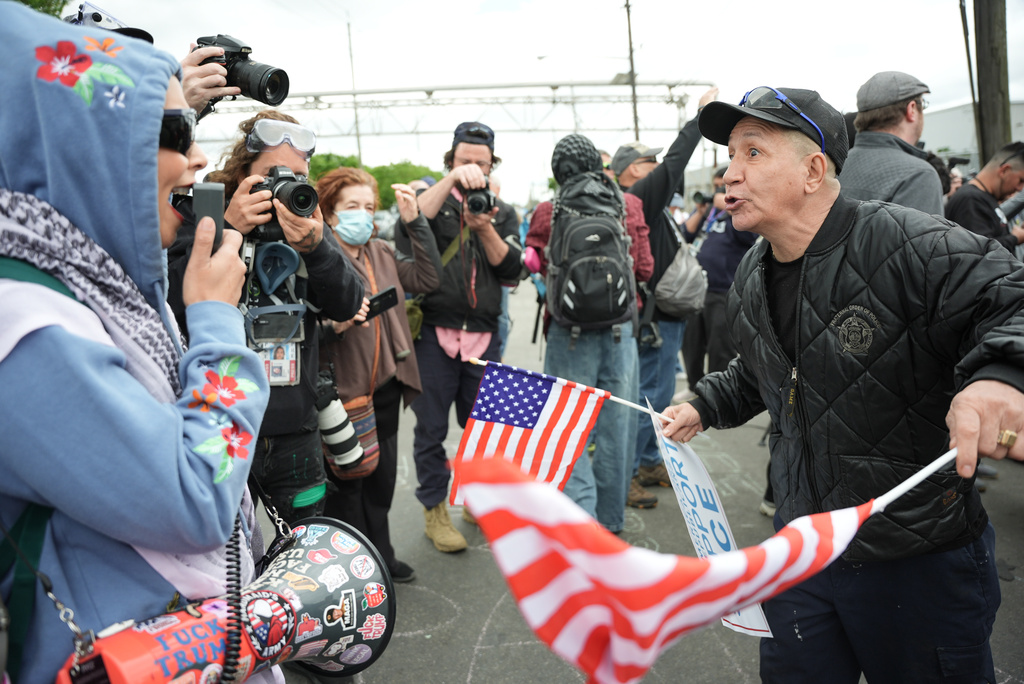
Protesters supporting Immigration and Customs Enforcement agents faced opposing demonstrators outside the Delaney Hall detention center on May 30, 2026, in Newark, NJ. This event reflects deep divisions across the United States, which are part of a broader trend identified by the Marquette Law School Poll. Researchers have found a marked decline in trust among different generations. People born before 1960 typically assume their neighbors mean no harm. They represent the most trusting group. However, trust diminishes with each generation. Those born since the 2000s exhibit the highest levels of distrust recorded by the project.
This distrust is not restricted to personal interactions. A survey by Pew Research Center covering 25 countries showed Americans increasingly view each other as morally deficient. Fifty-three percent of U.S. adults believe the average American has poor morals and ethics, a figure higher than in other surveyed countries. This distrust has grave implications. Societies cannot function smoothly when people lose faith in each other’s fundamental decency. Morality serves as an invisible software that guides social interactions. Losing trust in this shared understanding jeopardizes the entire social fabric, turning it into a constant conflict.
Political or cultural opponents perceived as merely wrong allow for dialogue. Viewing opponents as irredeemably immoral prevents compromise. Such perceptions foster an environment of contempt. This emotion has dominated American politics in the last decade. Public emotion has shifted from mere anger to deep-seated disgust. Relationship expert John Gottman’s research identifies contempt as a top predictor of failed marriages. He describes contempt as a toxic mix of hostility and ridicule, placing oneself morally above others. Gottman found that relationships degenerate to a point of no return when parties communicate through mockery and disdain.
A nation functions as an immense web of interpersonal relationships. It resembles a gigantic marriage among countless individuals sharing a space they didn’t choose. Currently, America’s social cohesion mirrors a fractured relationship in the final stages of breakdown. People are isolated, hurling insults, and hoping for each other’s downfall.
This fragmentation persists due to its economic incentives. Media algorithms, fundraising operations, and cultural gatekeepers profit from perpetuating contempt. A peaceful, united populace is less lucrative under this model. America has monetized animosity among neighbors. To sustain this, people remain engaged through anger, donations, and division. Political campaigns fuel these divisions by presenting opposition as an existential threat. The result is a cycle of distrust, breeding contempt, and further destroying relationships. This ongoing cycle secures the outrage industry’s funding and growth.
Young adults today have never known a society prioritizing cooperation. They witnessed adults treating political rivals as survival threats. The Marquette data is not an anomaly but a forecast for the next three decades. The nation is caught in a cycle—distrust leads to contempt, and contempt breaks relationships. This breakdown ensures the next generation intensifies animosity. America’s unity is now challenged by both physical separation and a psychological divide that seems impossible to bridge.
John Mac Ghlionn, a writer and researcher, examines culture, society, and technology’s impact on daily life.
Copyright 2026 Nexstar Media Inc. All rights reserved. This material cannot be published, broadcast, rewritten, or redistributed.
Leave a Reply