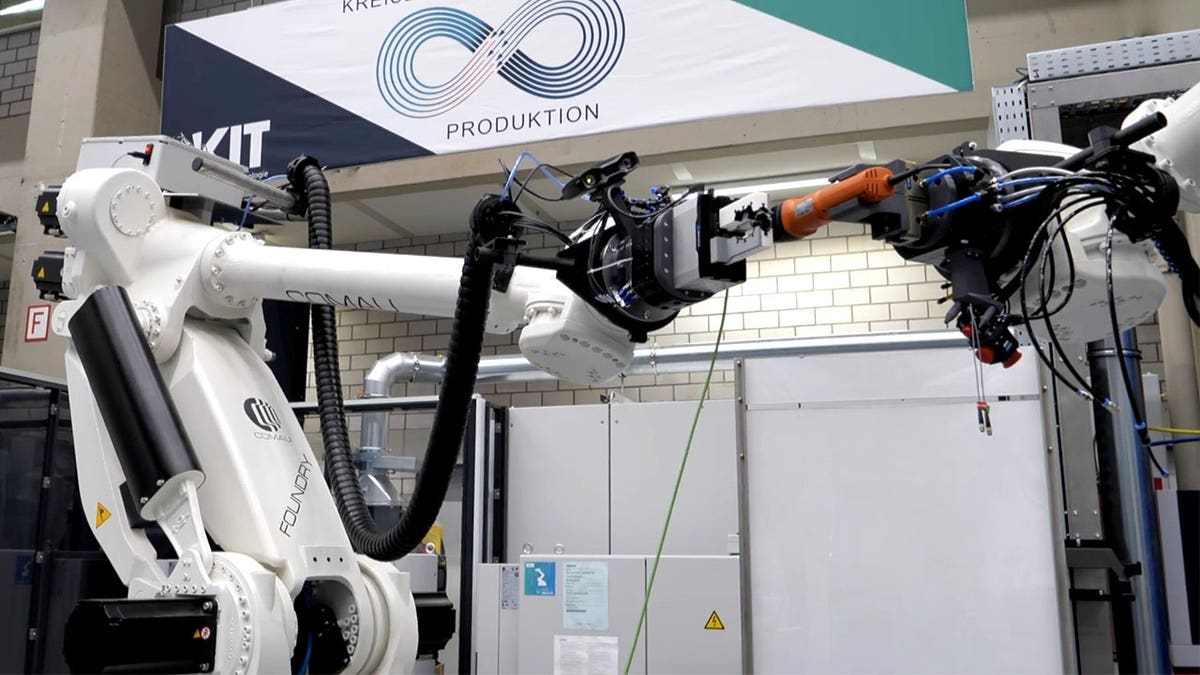
For several decades, robots have played a crucial role in manufacturing, efficiently assembling the products we use daily. However, researchers are now teaching them an equally vital skill: disassembling these products when malfunction or damage occurs. Over 4.6 million industrial robots are currently operational worldwide. As manufacturers increasingly automate production, the rising demand for industrial robots prompts questions about handling machinery when parts wear out or fail.
A team of researchers at the Karlsruhe Institute of Technology in Germany has developed a robotic disassembly system to address these challenges. This system employs probabilistic planning, allowing robots to adapt when they encounter obstacles with damaged or aging machinery. The system acknowledges the unpredictability of old machines, such as stuck screws, missing components, or mismatched original designs, and adjusts its plan accordingly.
The robotic system begins with a CAD model illustrating a product’s design, enabling it to identify discrepancies in component behavior. If a part moves contrary to the model’s predictions, the system updates its understanding of the machine. For instance, if a screw displays unexpected movement, the robot can revise its approach based on new information.
The research utilizes a Partially Observable Markov Decision Process (POMDP), which allows the robot to make decisions based on probabilities and continuously update assumptions. This approach combines CAD data, inspection details, and the capabilities of the robot itself.
The system’s adaptability was demonstrated in experiments, such as encountering a stuck screw in an electric motor. Initially, the robot attempted to unscrew the fasteners. Upon discovering resistance from one screw, the system employed a milling tool to remove materials and access the desired part. In another scenario, the robot avoided futile efforts by recognizing a missing screw in an angle grinder.
This adaptability is crucial since traditional deterministic planning fails with uncertainty but performs well when all components behave as expected. The probabilistic system excels in scenarios with stuck parts, producing faster disassembly times when alternative routes are accessible.
The research highlights a future where robotic disassembly could apply to larger systems, potentially leading to automated facilities where robots handle different tools for various tasks. Baumgärtner envisions a setup where multiple robotic arms address complex disassembly challenges.
The ultimate aim is facilitating a circular economy where manufacturers recover valuable components instead of discarding entire devices. The system can prioritize components during disassembly, adjusting strategies to preserve significant parts as indicated by manufacturers. Although commercial implementation remains a goal, the vision includes automated processes that extract, replace, and reconstruct products cost-effectively.
This innovation hints at changing manufacturers’ perspectives on broken products, potentially addressing the issue of e-waste from discarded electronics. If robotic systems manage damaged products efficiently, manufacturers could retain more valuable parts, making refurbishing more viable.
While immediate implementation seems unlikely, this research opens possibilities for manufacturers to consider automation’s role in handling defective products. By facilitating component recovery, automation could reduce electronics’ e-waste, reflecting in decreased discarded hardware due to minor faults. Future product designs could incorporate automated disassembly considerations for easier repair and recycling.
Kurt Knutsson, the CyberGuy, emphasizes the significance of robots handling uncertainty, potentially unlocking useful applications. He invites readers to share their thoughts on whether cheaper electronic repairs via robots could alter device retention or if manufacturers will always encourage new purchases.
Leave a Reply