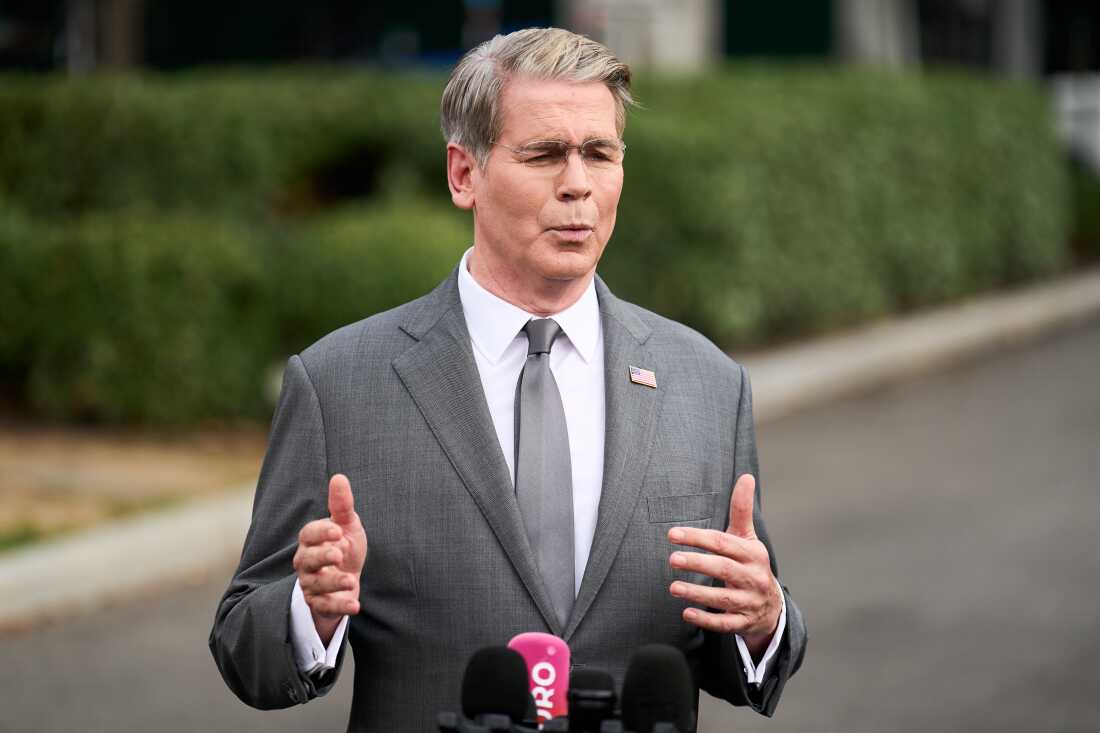
Outside the White House in Washington on Thursday, August 20, 2026, Treasury Secretary Scott Bessent addressed the media with plans to announce a significant new set of economic sanctions targeting Iran. This move, which President Trump has labeled as an ‘economic D-Day,’ is intended to challenge nations that provide economic support to Tehran.
The anticipated sanctions have already impacted Iran’s economy, as their currency, Rial, has plummeted to a historic low. The focus of these new sanctions will be on governments as well as businesses that enable Iran to circumvent financial prohibitions. Bessent has expressed a determination to break every financial support to the Iranian leadership, emphasizing the consequences for countries that maintain trade relations with Iran. China, a major purchaser of Iranian oil, has been specifically cited for buying a substantial portion of the country’s oil exports.
However, experts like Alan Eyre, a former diplomat involved with the U.S. in negotiations regarding Iran’s nuclear program until 2015, express skepticism about the efficacy of additional sanctions. Eyre suggests that the current sanction strategies have been exhaustive, leaving little room for further effective measures.
Iran’s response has been assertive, with Mohsen Rezaei, the new security chief, stating that Iran would retaliate significantly against President Trump’s economic maneuvers. Rezaei, previously leading Iran’s Revolutionary Guards, has warned Gulf states against endorsing these sanctions, declaring that any supporter would be perceived as an adversary.
In recent months, in response to U.S. and Israeli actions, Iran has conducted attacks on U.S. bases in the region, including locations in the United Arab Emirates, Kuwait, and Saudi Arabia, resulting in both injuries and fatalities. Rezaei has further warned of targeting oil tankers in the Persian Gulf, potentially exacerbating existing disruptions to energy exports and affecting global oil supply.
For ordinary Iranians, additional sanctions could further deteriorate their dire economic conditions. While the nation has endured prolonged U.S. sanctions dating back to 1979, the recent conflict has intensified economic hardships with staggering inflation rates nearing 90%.
A 30-year-old Iranian woman shared her struggles with NPR, revealing how financing basic needs like food through credit has become commonplace due to lack of cash. She described how essential medicines have become unaffordable, and regular life interrupted by power cuts and mounting unemployment. Earlier this year, economic distress, combined with high living costs, prompted street protests faced with severe suppression by the government.
Leave a Reply