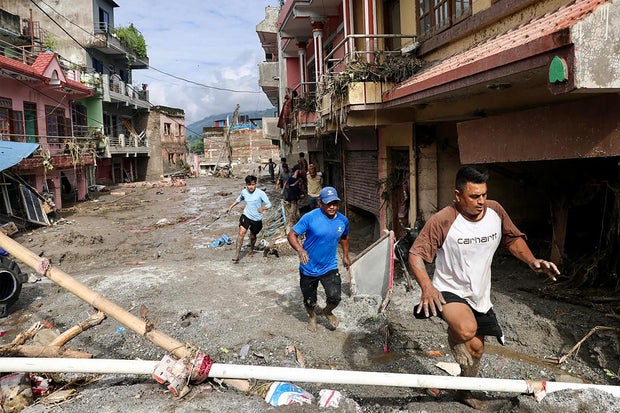
Rescue teams are conducting urgent searches along the Nepal-China border after a deadly flood and mudslide followed a glacial collapse. According to Nepal’s National Disaster Risk Reduction and Management Authority, 826 individuals are missing, and the country’s flash flood death toll has climbed to 165 as of Thursday. Nepalese authorities have intensified operations in the heavily affected districts of Nuwakot and Rasuwa.
Chinese state broadcaster CCTV reports that in Tibet, 558 people remain missing, including 260 foreigners, and three deaths have been confirmed. Two villagers have been rescued. The flash floods destroyed villages, houses, bridges, roads, and power plants. Videos show torrents of muddy water ravaging valleys and mountain passes, demolishing infrastructure and swept away buildings.
Drone footage captured the widespread destruction, including roads devastated and buildings buried under thick mud. Economic lifelines in the steep valleys were affected, with images showing the second floors of buildings covered in mud.
Local residents struggled amid the chaos.
“When I reached Dhunge bazaar, in half an hour, the flood came and damaged all the market. People were preparing to go to office then,” stated resident Shoyam Rajbhandari. “How many people are missing or dead, we don’t know.”
Search and Rescue Efforts
The Nepalese army deployed helicopters early Thursday morning, rescuing over 100 people from flood-hit areas. Brigadier General Raja Ram Basnet confirmed at least eight foreign nationals were airlifted to Kathmandu. Rescue teams located bodies approximately 62 miles downstream in Chitwan district, and numerous injured individuals received medical treatment in Kathmandu.
In Tibet, a mudslide near Gyirong Port caused significant road damage. Mud accumulation reached over five feet deep, complicating access and communication.
Ongoing Challenges
Authorities identified a barrier lake near Gyirong Port, posing further barriers to rescue operations. Chinese officials dispatched military aircraft to the affected region. Aside from the Nepalese casualties, reports indicated hundreds of missing foreign nationals, including Indian pilgrims visiting Mount Kailash, a sacred Hindu site in Tibet.
Secretary of State Marco Rubio expressed solidarity, offering humanitarian assistance and issuing a statement of support via social media. The U.S. Embassy in Nepal provided condolences to affected families and committed to deploying an advisor and funds for relief efforts. Buddhist leader the Dalai Lama expressed grief and support to those impacted.
Glacial Collapse Identified as Cause
The U.S. Geological Survey initially reported a magnitude 4.4 earthquake but revised its analysis to indicate a magnitude 5.2 glacial collapse as the disaster’s catalyst. The event produced a catastrophic debris flow, based on seismic and satellite data.
Experts from the International Centre for Integrated Mountain Development attributed the flash floods to a glacier-induced avalanche. Observations revealed the flood’s exceptional speed and magnitude, with water levels rising dramatically in a short timeframe.
Impact of Climate Change
The Lhende Khola river system, affected twice in 14 months, faces increased instability due to climate change. A disaster risk reduction specialist highlighted the critical need for early warnings in the warming Himalayas. Climate-related disasters in Nepal and Tibet illustrate broader vulnerabilities in the region.
Past flash floods, including last year’s Tibetan glacial lake overflow, reflect ongoing risks. The Himalayan range’s populous and vulnerable areas face mounting threats from melting glaciers and intense monsoons. Researchers found increasing glacier melt rates, accentuating global climate concerns.
Leave a Reply