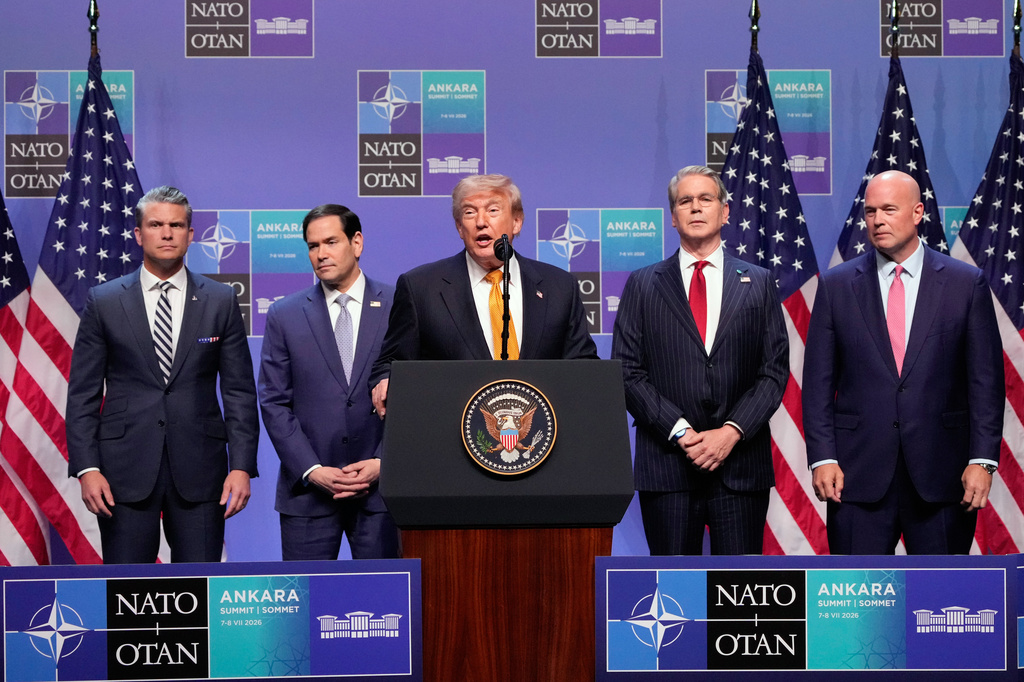
During a media conference at the NATO summit in Ankara, Turkey, on July 8, 2026, President Donald Trump addressed key geopolitical issues. Joined by prominent figures such as U.S. Defense Secretary Pete Hegseth and Secretary of State Marco Rubio, he emphasized the importance of being ready for the resolution of current conflicts in Europe and the Middle East.
Historical patterns show Russia’s use of military force to achieve political goals. From the invasion of Georgia in 2008 to the annexation of Crimea in 2014, and the full-scale invasion of Ukraine, Russia’s actions demonstrate an imperial ambition. The country’s commitment to a war-time economy and enduring economic sanctions underscores its tenacity. This poses a threat to Eastern Europe’s fragile democracies, including the Baltic states and Poland. Strong responses demand European partners to cover any weaknesses left by U.S. military reductions in the area.
China, ruled by the Communist Party, uses economic and cyber strategies to expand its influence. Although talk of reunifying with Taiwan persists, China has not engaged in major warfare since a failed operation in 1979. Chinese military strategy focuses on deterrence and economic influence. The potential repercussions of a military move against Taiwan, such as uniting the West and damaging its economy, restrain China’s actions.
The U.S. should maintain and enhance alliances in the Indo-Pacific region, strengthening deterrence and ensuring freedom of navigation. Strategic efforts should address active and escalating violence, with Europe requiring support as a cornerstone of Western democracy. This commitment to European security sends a clear message to adversaries. Reinforcing NATO’s defenses and updating military infrastructure are crucial investments in deterrence.
Current U.S. defense initiatives prioritize a future war with China that might not happen, while munitions stockpiles in Europe and the Middle East reveal weak points in the industrial base. Sustaining global leadership requires rebuilding this capacity centered on present threats. Supporting NATO allies does not diminish the Indo-Pacific strategy, but reinforces global deterrence.
The U.S. Army and Air Force need investment, while the Navy remains vital in the Indo-Pacific. Securing the European theater relies on land and air strength, rapid logistics, and intelligence collaboration. China’s observation of a united NATO acts as deterrence itself, influencing peace in the Pacific.
Focusing the U.S. military appropriately is critical. Russia’s actions test the world’s resolve, emphasizing the need to decisively confront aggression in Europe. Strengthening European allies can prevent greater strategic dilemmas, potentially reducing future costs in American lives.
Keith Self represents Texas’s 3rd District in the House of Representatives and serves on key committees. With 25 years in the U.S. Army, his perspective highlights the importance of military preparedness and strategic clarity.
Leave a Reply