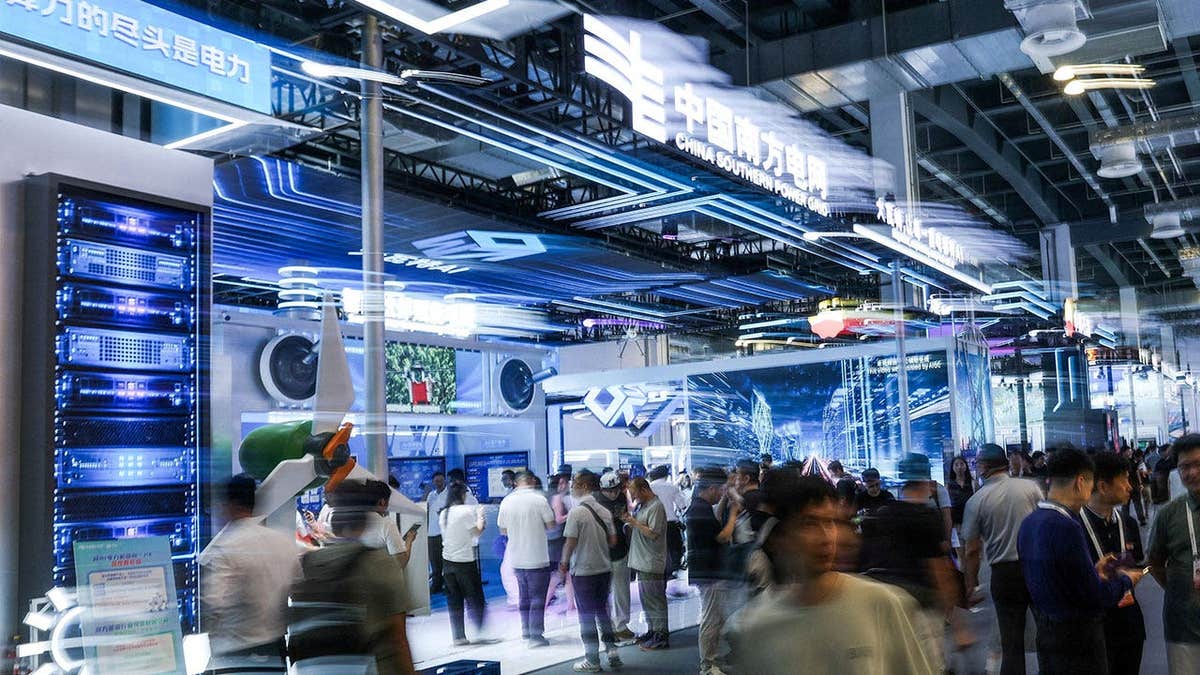
China is rapidly developing data centers and energy infrastructure essential for advancing artificial intelligence. This expansion raises concerns that China’s ability to swiftly construct large-scale projects could help it narrow the lead America holds in AI-related physical infrastructure.
The United States dominates in terms of the number of data centers. According to the Stanford Institute for Human-Centered Artificial Intelligence’s 2026 AI Index, there were 5,427 U.S. data centers in 2025 compared to 449 in China. However, Stanford noted this count does not reflect differences in facility size, computing capacity, or utilization.
China, despite being behind, is advancing quickly. Gordon Chang, a China expert, told Fox News Digital that Beijing recognizes the American advantage will be difficult to overcome if the U.S. maintains its building momentum. He pointed out that growing opposition to new data-center projects may hinder U.S. expansion.
“China could not be happier with this anti Data Center movement,” former President Donald Trump wrote on Truth Social.
Trump stated that embracing data centers brings jobs and increased tax revenues. Vice President JD Vance also warned on Fox Business that the U.S. might lose the AI race to China if Democrats regain control of Congress. Vance emphasized the importance of expanding power infrastructure to support data centers without burdening residential ratepayers.
Currently, China generates about three times more power than the United States. Vance stressed the need for more power plants and regulatory improvements.
The Chinese Embassy in Washington suggests viewing AI as a cooperative international endeavor rather than a geopolitical contest. China’s 2025 Global AI Governance Action Plan aims for cooperation with the U.S. and advocates benefiting the broader international community.
China is reshaping its computing infrastructure under the “East Data, West Computing” strategy, focusing on western regions to utilize available land and renewable resources like wind and solar energy. Five of China’s eight national computing hubs are located in these areas, including projects in Inner Mongolia and Ningxia.
Members of the bipartisan US-China Economic and Security Review Commission noted during a trip to China that Beijing sees AI as a competitive frontier intertwining with robotics, biotechnology, advanced materials, and manufacturing.
Vice Chairman Mike Kuiken acknowledged China’s faster construction pace due to flexible rule-making and minimal legal constraints. However, he pinpointed China’s inability to access advanced chips as a significant weakness.
Beyond sheer data-center numbers, the U.S. holds advantages in AI model production and private AI investment. In 2025, the U.S. developed 59 notable AI models versus China’s 35, and private U.S. AI investment reached $285.9 billion compared to China’s government-heavy $12.4 billion. Yet, Chinese models have narrowed this performance gap significantly, with the top U.S. model leading China’s by just 2.7% as of March 2026.
Gordon Chang alleges that some protests against U.S. data-center projects may be supported by China-linked networks. Kuiken urges caution, emphasizing that genuine U.S. opposition arises from concerns over costs, environmental impact, and land development. He noted that infrastructure constraints are being addressed by policymakers.
The competition extends beyond developing smart AI models. It focuses increasingly on building the necessary infrastructure to support large-scale and high-speed operations.
Efrat (Effie) Lachter is a Fox News Digital reporter with extensive experience in conflict, global affairs, and political accountability. Her work spans more than 40 countries and covers significant world events.
Leave a Reply