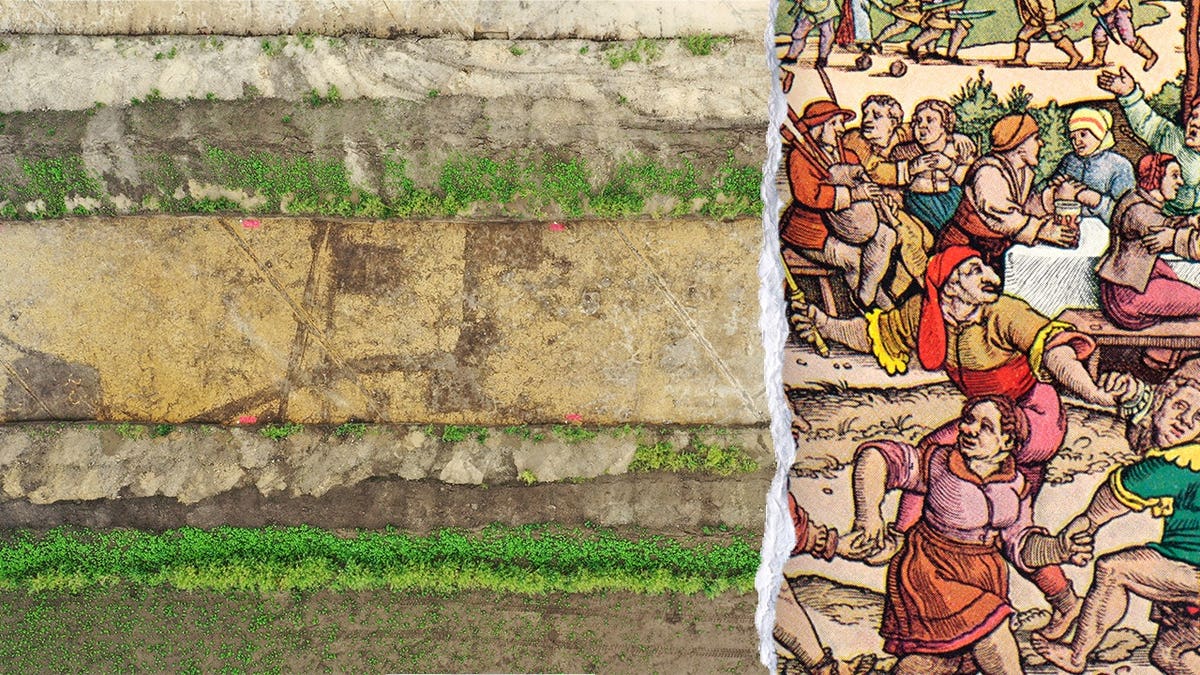
Recent archaeological findings in Germany have sparked intrigue with the uncovering of a medieval village that was abandoned for unknown reasons. The site, located at Am Frevelgraben in Halberstadt, Saxony-Anhalt, revealed remnants of a complex settlement complete with a multi-tiered ditch system.
Excavation Uncovers Historic Site
Excavations commenced in March as part of preparations for a new industrial park. Researchers suspect this site may coincide with Kühlingen, a medieval village referenced in historical documents. Key discoveries at the site include rows of pit houses, several settlement pits, and two wells. Evidence also suggests extensive use of the nearby riverbank by the former inhabitants.
The settlement’s layout indicates it developed in two distinct phases, with overlapping structures and adjacent homes showing expansion over time.
A Surprising Lack of Artifacts
Despite well-preserved structural remains, archaeologists reported finding surprisingly few artifacts. This scarcity contrasts with typical medieval village sites. The artifacts found include scattered ceramic shards and a few metal objects like a bronze tap, fittings, and belt buckles.
“It was indeed striking how few artifacts were left behind,” Oliver Dietrich, spokesperson for the State Office for Heritage Management and Archaeology, remarked.
No evidence of destruction or fire was found, adding to the mystery of why the village was left.
Ongoing Research
Further analysis is expected to shed light on the precise abandonment date. Radiocarbon dating of animal bones might offer more accurate timelines.
Dietrich noted that the abandonment might relate to broader historical trends during the 14th and 15th centuries, such as the Black Death, migration, and climate change. These factors often led to resource shortages, resulting in deserted settlements.
Parallel Discoveries
This finding is not unique in the region. Earlier this year, a similar abandoned medieval settlement was found in Poland, hidden in a forest.
Leave a Reply