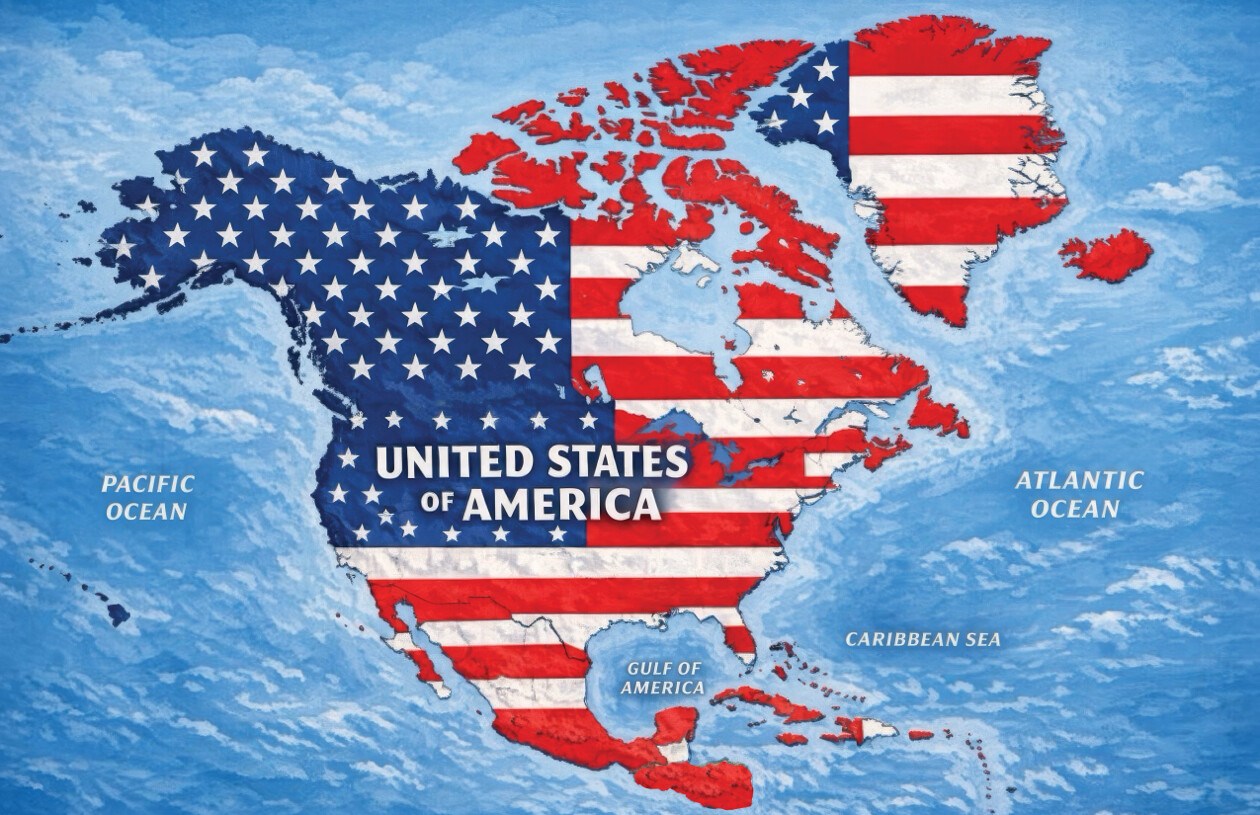
Recently, President Donald Trump made waves by sharing a map on Truth Social depicting all of North America as part of the U.S. This map, likely created with AI, appeared as a cheeky statement reflecting Trump’s ‘America First’ policy, termed the ‘Donroe Doctrine,’ echoing the Monroe Doctrine.
This incident follows Trump’s escalation of trade tensions with Canada. Economically, the U.S. and Canada are clashing, but the issues go beyond trade. Trump has previously alluded to viewing Canada as a ’51st state’ and has expressed interest in acquiring territories like Cuba, Greenland, Mexico, and the Panama Canal. Official changes, such as renaming the Gulf of Mexico to the Gulf of America and Lake Ontario to Lake America, underline this antagonistic approach.
“We have always been able to work out agreements that accommodate differing perspectives on these boundary issues,”
said Rob Huebert from the University of Calgary, acknowledging that these disputes existed before Trump’s administration. However, Trump’s policies strain the historically strong U.S.-Canada relationship. Many Canadians are uncertain about the implications of Trump’s policies and what objectives they serve.
Arctic Disputes Deepen
A significant ongoing contention involves Arctic waters in the Beaufort Sea, believed to hold rich oil and gas reserves. Both countries differ in interpreting the maritime boundary, rooted in an 1825 treaty between Russia and Great Britain. Canada maintains that the boundary extends north along the 141st meridian, while the U.S. has another view, further complicating continental shelf claims.
Negotiations began in November 2024, but progress halted as of October 2025. The Northwest Passage dispute adds another layer, as the U.S. views it as an international strait, but Canada claims it as its own.
Cross-Border Concerns
The Arctic tension also involves Russia and China, both showing increased interest in the region. Trump’s aggressive stance on Greenland raises further questions about Arctic security for both the U.S. and Canada. As per Adam Lajeunesse at St. Francis Xavier University, Canada’s Arctic capabilities have grown, but a disagreement could deny U.S. military easy access, which has been conflict-free since the 1950s.
Persistent Maritime Disputes
The U.S. and Canada also dispute sovereignties over Machias Seal Island and North Rock near the Bay of Fundy. The U.S. cites post-war treaties as evidence, while Canada references Britain’s historical lighthouse there. The status of these areas remains unresolved.
Additional disagreements linger over Pacific waters in the Dixon Entrance and the Strait of Juan de Fuca. While these issues have been managed diplomatically in the past, strained relations could complicate future resolutions.
“There is no good reason for reviving either dispute, because they are well-managed,”
said Michael Byers from the University of British Columbia, underscoring the need for negotiation. Attempts to reignite these issues risk destabilizing diplomatic ties.
Canada’s Response to U.S. Actions
Canadian Prime Minister Mark Carney has rallied domestically in light of Trump’s provocations, including economic retaliation through tariffs on U.S. goods. Carney emphasized Canada’s resilience against what he described as ‘American aggression,’ drawing from historical resistance against expansionist U.S. policies.
Trump retaliated by threatening to ban Bombardier aircraft sales unless manufactured in the U.S., emphasizing ‘America First’ in bold claims on Truth Social.
These aggressive tactics occur amidst broader international responses. Mexican President Claudia Sheinbaum emphasized her country’s sovereign status. The Foreign Ministry of Iceland, mistakenly included in Trump’s map, called in the U.S. ambassador, while Denmark reiterated Greenland’s independence from possible U.S. control.
Leave a Reply