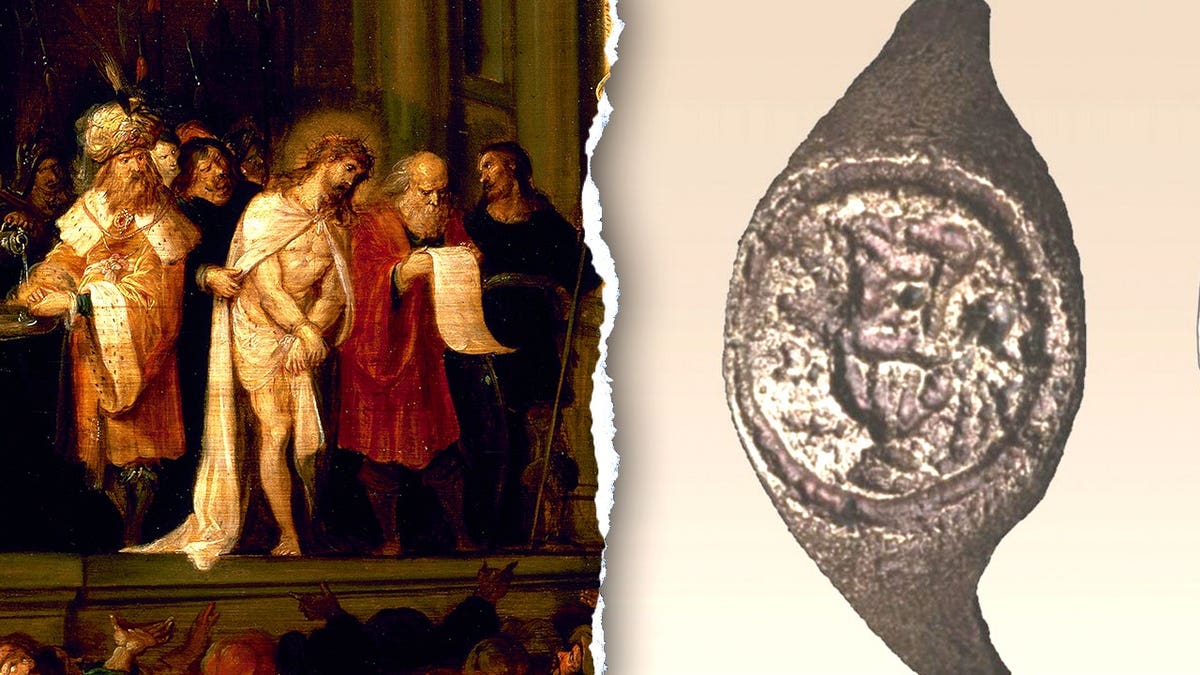
New research about an ancient ring bearing an inscription tied to Pontius Pilate may offer insights into how the Roman governor wielded power. Lot of time has passed since Pilate sentenced Jesus Christ to death, but the discovery can shed new light.
The ring was found at Herodium, a fortress atop a mountain in the Judean desert, during the 1960s. Although known to archaeologists for decades, a recent interpretation might illuminate its connection to Pilate. Stored for over 50 years, details about the 2,000-year-old ring were published in 2018, as noted by a University of California, Los Angeles (UCLA) release.
A challenging study questioned its link to Pilate, prompting a debate addressed by Catherine Bonesho, a UCLA professor of ancient Judaism, in a new publication in Palestine Exploration Quarterly.
Bonesho’s study suggests the ring’s inscription is a Latin-to-Greek transliteration of PILATO, meaning “for Pilate” or “to Pilate.” It contradicts earlier views that described it as a misspelled or shortened Greek version meaning “belonging to Pilate.” The theory posits that the ring did not belong to Pilate himself, but perhaps to a lower-status worker managing related administrative tasks.
“Deciphering the ring’s meaning offers more perspective on the Roman administration in early Roman Judea regarding how authority decentralized,” Bonesho shared in a UCLA press release. “Considering the ring’s poor quality, its Greek transliteration, and seal ring usage by enslaved or formerly enslaved workers, we gain insight into historical events,” she remarked.
The Getty Images show the ancient ring found at Herodium during the 1960s archaeological digs. (Images via Getty; IAA Photographic Dept., Roi Porat)
Candida Moss, a historian of early Christianity, described the research as fascinating. She highlighted that the new interpretation could solve why the cheaply made ring is linked to Pilate.
“You would expect a Roman governor to own a more expensive ring,” Moss said.
The ring might have been used by someone working under Pilate, exercising his authority. “Such individuals used his ring to seal legal and business decisions, implying they represented Pontius Pilate and the broader Roman administration,” Moss explained.
The ring’s archaeological significance might offer new biblical insights, particularly with the Gospel of John’s narrative of Jesus’ crucifixion. John’s account mentions Pilate writing the inscription identifying Jesus as “King of the Jews.”
Moss suggested the ring demonstrates how actions taken by Pilate’s subordinates could be attributed to Pilate himself. “It helps clarify why the Bible claims Pilate wrote the inscription on Jesus’ cross, although historians know he couldn’t have written it personally,” she noted.
In conclusion, the ring offers a deeper understanding of the delegation of authority within the Roman administration in Judea.
Leave a Reply