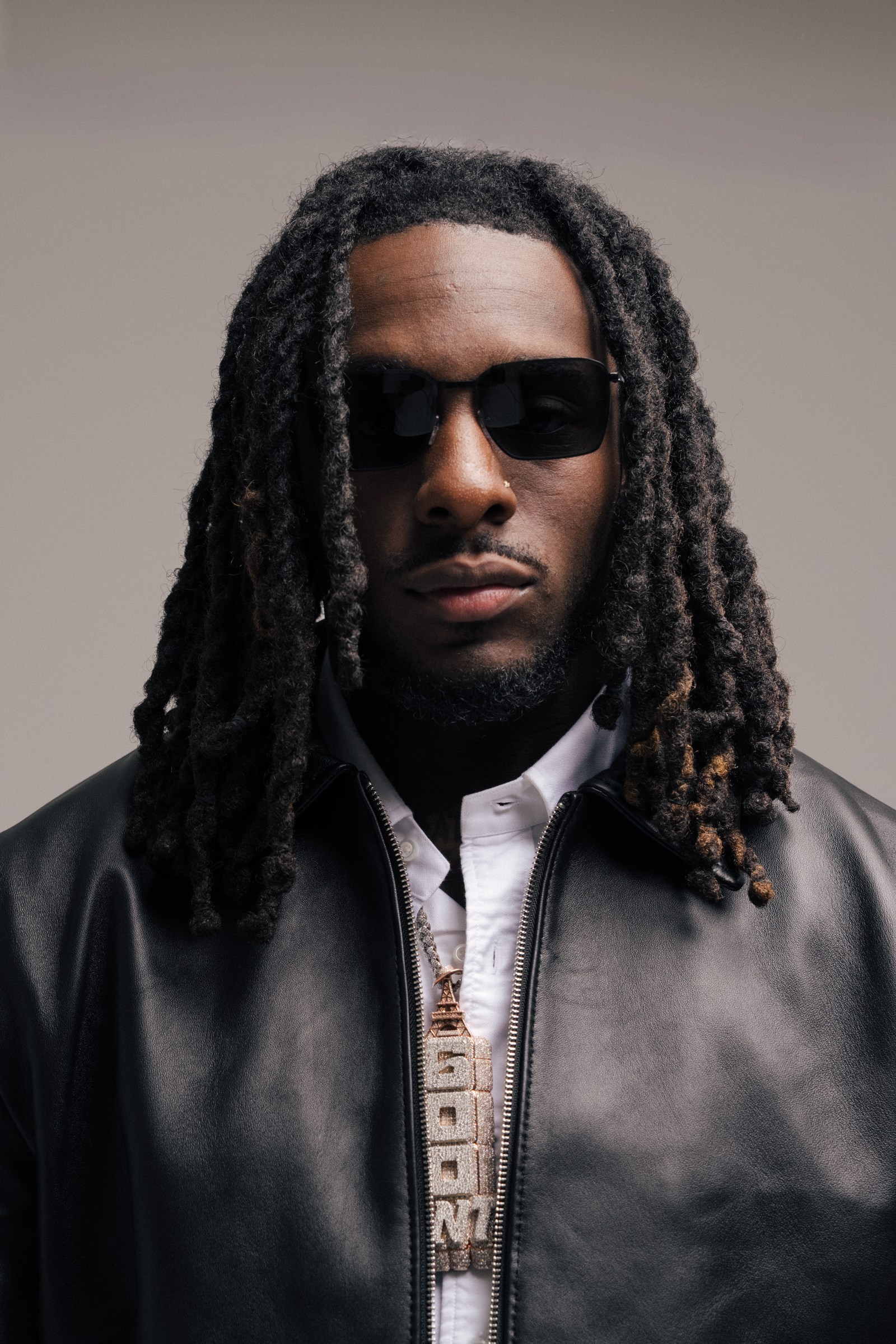
Before Ro$ama had a studio, he had a PlayStation, a cassette recorder, and a circle of childhood friends in Paris, Texas. In 2009, the video game 50 Cent: Blood in the Sand provided instrumentals, while his imagination created the rest. Ro$ama recalled, “Once you beat the game, they give you all the instrumentals.” He positioned the television beside the recorder, pressed play, and began freestyling at nine years old. For him, the beat didn’t matter; the act of creating music quickly became a family tradition.
Family events included informal freestyle battles, and relatives expected Ro$ama to perform whenever everyone gathered. He noted, “They knew we would freestyle on the cassette tape, so they would make me rap during the family reunion,” laughing about the requests, which have continued into his adult life.
A Family Name Finds Its Sound
The echoes of those early days reverberate through My Forte, Ro$ama’s newly released solo album. Its title connects musical ability to maternal lineage. “Forte is my mama’s last name,” Ro$ama explained. The musical meaning of ‘Forte’ and its link to one’s strongest skill provided him with a deeply personal concept. “Music and my mama’s last name correlated,” he said. The coincidence offered a framework broad enough for diverse subjects, revealing his range.
The album’s 20 tracks allow Ro$ama to explore reflection, flexing, and regional storytelling. He stated his aim: “I was trying to do different types of topics and skill-based songs to show I can do a lot of things.”
Writing Backward, Landing Forward
Ro$ama’s ambitions were influenced by artists who viewed rap as a proving ground, such as Lil Wayne, T.I., DMX, the Notorious B.I.G., Tupac Shakur, Nipsey Hussle, and Ludacris. Wayne’s wordplay was an exacting benchmark because, as Ro$ama described, “I love how he played with words and how he made you think.” This admiration fueled his competitive urge: “I always wanted to do or be better than him doing it, to show he ain’t the only one who could do it.”
Ro$ama’s creative process begins with a beat, guiding the emotional direction. However, his bars often emerge from the end and move toward the beginning. “I write backwards,” he explained. “I find my last bar of the four-bar setup, and I work backwards.” The final punchline is the anchor, and he builds the preceding three bars to enhance the impact. With the ending fixed, each setup strengthens the delivery. “So long as I got this last one, I can make it set up, and it’ll hit you,” he said.
This method lends his verses an architectural feel, as his similes, metaphors, and layered meanings are structured for impact while the narrative flows. “Rap was always storytelling, lyricism, double, and triple entendres,” Ro$ama said. Despite his influences spanning regions and eras, the East Texas perspective remains the foundation.
Two Sides of the Story
On “E.T.,” a track showcasing his craft, a beat switch lets Ro$ama weave a personal story across two energies without losing its thread. The slower opening allowed storytelling build-up; when the beat changed, he accelerated while maintaining the narrative. “When the beat switched, I was like, I can pop it and keep the story going as well,” he stated.
Another track, “93,” reflects conditions in his hometown, while “E.T.” captures “my current stage in life, and then my ups and my downs.” Together, these songs show how Ro$ama shifts between autobiography and community observation. Even when emphasizing the album’s focus on skill, his strongest pieces are rooted in personal experience.
This instinct also led him to film music, with Ro$ama appearing on “BEAST MODE (Godzilla x Kong).” He prepared by previewing the movie, visualizing its scale, and responding to the energy of BigXthaPlug’s verse. “I really just came on there trying to beat his verse and talk about the movie too,” Ro$ama said. The friendly rivalry fit a song tied to cinematic giants while showcasing the competitive logic driving his solo work.
From the Room to the Center
The collaborative project 6WA expanded Ro$ama’s platform, changing how audiences acknowledged him. “I felt like I was in the room, but people didn’t notice me,” he said. Following the project’s release in February 2026, people connected his voice to the artist. “Oh, you’ve been here, but I didn’t know it was you.”
6WA brought Ro$ama together with BigXthaPlug, MurdaGang PB, and Yung Hood under the 600 Entertainment banner. For Ro$ama, the project was akin to a tryout, creating expectations for future work. “6WA was like the preseason, like trying to make the cut. Now I finally got y’all attention. Let’s see what he’s gonna do in the regular season.”
A headlining set at Rolling Loud underscored this shift, with Ro$ama reversing a usual arrangement and bringing BigXthaPlug onstage during his performance. “Instead of X bringing me out, I brought him out,” he explained. The gesture expressed gratitude and symbolized his journey from overlooked to central figure.
With My Forte, Ro$ama wants listeners familiar with his collaborative records to hear his full range, honed since those cassette tape sessions in Paris, Texas. “I just want to let them know I can do everything,” he said. “I’m coming for everything.”
Leave a Reply