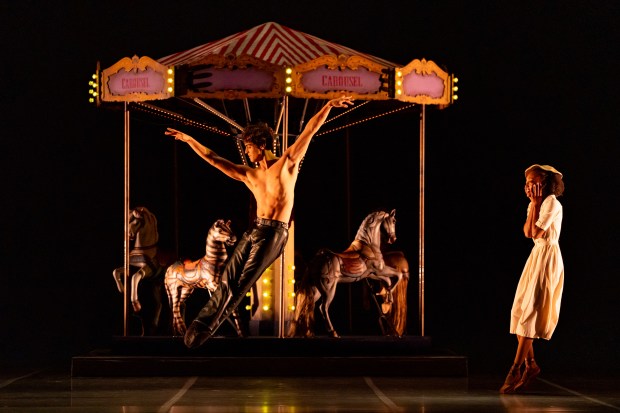
Liliom, the Joffrey Ballet’s season opener, introduces audiences to Julie, portrayed by prima ballerina Victoria Jaiani. Julie’s kindness and naivety land her in a difficult situation when she falls for Liliom, a carnival barker played by José Pablo Castro Cuevas.
While Julie’s goodness leads to tough decisions, the ballet centers on Liliom’s moral struggle. Created by choreographer John Neumeier, Liliom challenges the trope of a devoted woman to explore whether a man can shape his fate.
Castro Cuevas impressively captures Liliom’s duality—as both a charming womanizer and a brooding, troubled soul. Neumeier’s ballet first premiered in Germany 15 years ago. However, his roots trace back to Chicago, where his career began in 1961 with a performance on the Lyric Opera’s stage.
“Moments in Liliom may be perplexing, reflecting Neumeier’s unique blend of classical ballet, modern dance, and physical theater,” says a review.
The dance embraces an unconventional movement style, inherited from Neumeier’s early training with Sybil Shearer in Chicago. His interpretation of the music—composed by Michel Legrand and wonderfully conducted by Nicholas Koo with the Lyric Opera Orchestra—elevates the ballet’s storytelling.
In a striking opening, Evan Boersma takes the stage as The Balloon Man, setting the scene with a burst of color against a drab backdrop. His character guides Liliom from Earth to spiritual realms, echoing classic literary tropes.
The narrative shifts to the peak of Liliom and Julie’s story. Neumeier, alongside set designer Ferdinand Wogerbauer and lighting designer Jim French, captures the vibrant atmosphere of a 1920s carnival. Costuming distinguishes between societal classes, underscoring the divide between the affluent carnival attendees and the struggling carnies.
Liliom’s charm and persuasive talents draw in carnival guests and intrigue his supervisor, Amanda Assucena. Despite his allure, Liliom’s darker tendencies lead to calamity—a reflection of choices rather than circumstance alone.
During the Great Depression’s onset, the ballet’s ensemble powerfully portrays economic despair. Men slowly crossing the stage with signs paint a poignant picture of the era’s challenges.
“Work is what I want and not charity,” reads one sign, echoing the societal struggles mirrored in Liliom’s decision to resort to crime and tragedy. But despite the hardships, Neumeier ends the ballet on a note of hope, showcasing Julie’s unwavering ability to love and see the best in others, including her son.
Review: “Liliom” – Rating: 3.5 stars
Running until Sept. 27 at the Lyric Opera of Chicago, this production hosts performances that captivate and challenge audiences.
Tickets range from $39 to $214, accessible through 312-386-8905 and www.joffrey.org.
Leave a Reply