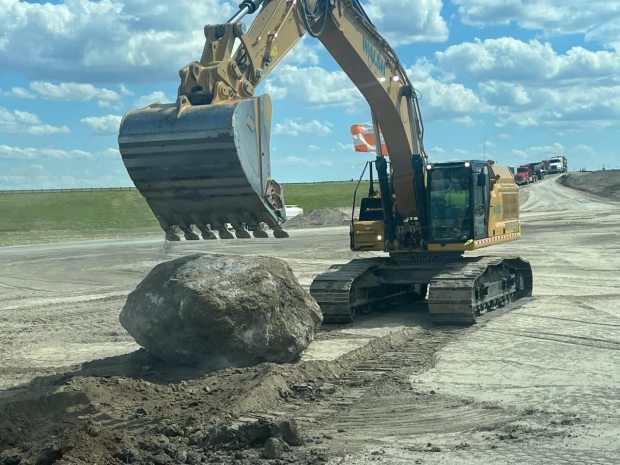
Ron Pitelka was 23 when he collected his first boulder while working at a construction site in Chicago’s suburbs. That rock, approximately 5 feet wide and egg-shaped, began what would become an extensive collection. Now 45, Pitelka, a Local 150 excavator operator, has amassed hundreds of rocks. Some are stored at his mother’s property in New Lenox, while about 100 are at his home in Homer Glen. They line his driveway, much to his neighbors’ annoyance.
This summer, Pitelka unearthed a 50-ton dolostone boulder from O’Hare International Airport’s airfield. During a project with Walsh Construction for O’Hare’s terminal modernization, he and bulldozer operator Matt Tracy discovered the rock. It lay 30 feet underground, according to Chicago Department of Aviation project manager Cortney Harris. This find is part of an $8.8 billion airport renovation effort.
Geologist examinations identified the boulder as dolostone, a sedimentary rock that makes up much of Illinois’s bedrock. Several years ago, elementary students campaigned for dolostone to become the state rock of Illinois. The Aviation Department is now inviting the public to name the large boulder. Suggestions like “Da Layover” and “The BaRock Obama Presidential Memorial Airport Boulder” have emerged from over 2,300 proposals.
“It makes me sick,” Pitelka said about burying or breaking up boulders to save costs.
Pat McLaughlin of the Illinois State Geological Survey says the rock material is over 400 million years old, initially formed in a tropical sea environment. Glaciers later moved chunks to their current location. “There was a shallow tropical sea,” McLaughlin explained, pointing to the ancient past when seashells became limestone and later dolostone. Clara Blättler from the University of Chicago mentions fossils could further date the rock.
The substantial boulder is now displayed at O’Hare’s Multi-Modal Facility, a key transportation hub. Pitelka’s journey with excavators began early, given his family’s background in excavating. He recalls playing on boulders his father placed outside their home. Pitelka continues to find joy in unearthing large objects, dreaming of discovering a meteorite someday. “The job requires skill, focus, and can be stressful, but it can also be fun,” he stated.
The city encourages residents to participate in naming the rock a little longer. Pitelka prefers a simple name, “Geo,” highlighting the boulder’s geological significance and long-lasting presence. “Long after I’m gone, that boulder will still be there,” he reflected.
Leave a Reply