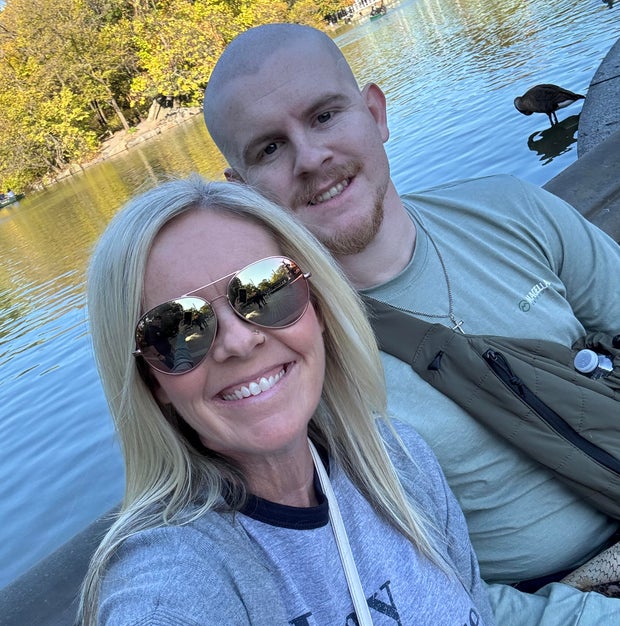
Eighteen months after being diagnosed with a rare brain tumor, 21-year-old Mason Henderson found that chemotherapy was ineffective against his disease, which had spread to his spinal fluid. In search of treatment, Henderson joined a clinical trial in New York City. Unfortunately, the trial also proved unsuccessful. Henderson faced uncertain prospects due to the rarity of his cancer, which the World Health Organization only named in 2021.
Earlier this year, Henderson’s doctors explored a genetically tailored drug therapy. They turned to Lynparza, developed by Merck and AstraZeneca, even though it wasn’t specifically approved for his condition. Typically, rare cancers lack a standard treatment protocol, and insurance often does not cover non-standard drugs. Despite support from specialists handling his case, his insurance refused coverage.
“They have no guidelines for his cancer,” said Tabitha Lowe, Henderson’s mother, citing what she viewed as discrimination due to the cancer’s rarity.
Insurance companies, when addressing rare cancers, often refer to FDA approvals and expert guidelines. Yet, rare cancer cases frequently don’t have targeted FDA-approved treatments. Diagnostic laboratories can indicate potential effective treatments, but coverage often lags behind scientific advances.
Henderson’s neuro-oncologists, Jacob Mandel from Baylor College of Medicine and Jessica Schulte from NYU Langone Health, believed in Lynparza’s potential based on limited but promising results in similar rare brain cancers. However, insufficient large-scale studies reduced the drug’s initial validation for Henderson’s type of cancer. Despite these challenges, the doctors remained hopeful due to Lynparza’s targeted mechanism.
Mandel prescribed Lynparza on January 16. By January 30, Henderson’s pharmacy benefit manager, Liviniti, denied the request. A subsequent explanation stated that Lynparza was “not approved for the diagnosis provided.” Without insurance, Lynparza’s cost was prohibitively high at around $8,700 monthly.
Mason Henderson was known as a vibrant, athletic young man until his diagnosis in March 2024. Before his condition changed, he was involved in sports and sought a law enforcement career. The initial tumor diagnosis came after a sudden and severe health episode at home, leading to emergency medical care and a subsequent surgery that removed a significant part of the tumor.
Henderson underwent chemotherapy and radiation over 16 months. In September 2025, his condition worsened as cancer reached his spinal cord, a scenario usually fatal in a few months. In collaboration with Schulte, Henderson participated in a clinical trial focused on craniospinal irradiation. This intensive treatment did not yield the desired results, but his family remained supportive and engaged with the process and the medical team.
Lynparza gained FDA approval in 2014 for ovarian cancer by interrupting tumor cell replication. After his insurer’s refusal, the Hendersons approached Jefferson County for financial support, as Henderson’s stepfather worked for the county sheriff’s office. Their appeal was denied after an independent review suggested an alternative that was not aligned with Henderson’s doctors’ recommendations.
Henderson’s family efforts to access the medication continued, including outreach to AstraZeneca, which initially declined the donation and to the county board responsible for benefits. Tara Parsell, an AstraZeneca spokesperson, cited confidentiality in response to inquiries.
Faced with continuous refusals, Tabitha Lowe went public via social media to secure treatment for her son, highlighting the barriers rare cancer patients face due to insurance policies. Her appeal gained wide attention, compelling AstraZeneca to supply the drug.
Despite these efforts, Henderson’s condition rapidly deteriorated, affecting his mobility and speech. After a brief use of Lynparza, Henderson passed away on May 4, 2026, with his family by his side. Hundreds attended his memorial, honoring his life and spirit. In his memory, a scholarship was established to support local high school graduates.
This detailed narrative of Mason Henderson’s battle sheds light on the systemic issues in U.S. healthcare, particularly for rare cancer patients. The bureaucratic hurdles greatly prolonged access to possibly life-extending treatments, underlining the need for adaptable insurance and treatment pathways.
Leave a Reply