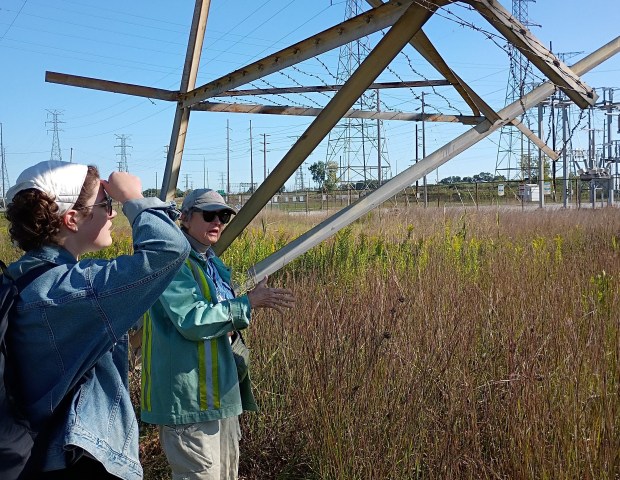
Tall transmission towers and high-voltage power lines stretch across the sky in Eggers Grove Cook County Forest Preserve, located on Chicago’s Southeast Side near the Illinois/Indiana border. Underneath, bike riders and hikers traverse paths lined with prairie plants and native grasses, carrying early fall seeds such as little blue stem, yellow prairie grass, goldenrod, whorled milkweed, purple coneflower, common milkweed, and coreopsis. Monarch butterflies fly amongst these flowers, stopping to rest as they make their journey south during their annual migration.
This landscape is one of 53 sites in northern Illinois where ComEd has adopted land management practices to support the monarch butterflies. Many have already departed for central Mexico, yet ComEd’s initiatives point to a larger movement to transform right-of-way areas into thriving habitats. Catherine O’Reilly, partner coordinator for Sustainable Landscapes at the Energy Resources Center at University of Illinois Chicago’s College of Engineering, states, “Any space with a supportive pollinator habitat is important for species survival.”
Six years ago, about 40 energy and transportation organizations joined to create the Nationwide Candidate Conservation Agreement with Assurances for Monarch Butterfly on Energy and Transportation Lands, also known as “Monarch CCAA.” This agreement, valid until 2045, calls for right-of-way landowners and managers to implement conservation efforts beneficial to the monarch.
O’Reilly notes, “This effort has gotten a lot of buy-in.” The Rights-of-Way as Habitat Working Group that developed the Monarch CCAA sees 9.3 million acres enrolled, with over 1.3 million acres adopted as habitat. In Illinois, where the Monarch is the state insect, commitments from energy utilities and transportation agencies have led to a significant rise in milkweed, the monarch’s host plant. Between 2014 and 2024, milkweed stem counts increased by 108 million, half of which occurred in right-of-way areas.
“Utility and transportation rights-of-way generally support pollinator and prairie habitats since they necessitate tree growth management,” O’Reilly explains. The Monarch CCAA capitalizes on this advantage by requiring specific practices such as reducing mowing, planting native species, controlling invasive plants with targeted herbicides, and conducting controlled burning and grazing.
A CCAA agreement for native bumblebee habitats also involves nest avoidance, O’Reilly adds. In pledged areas, ComEd implements these measures, including controlled burning conducted by trained professionals with special permits. “CCAAs are legally binding and suggest measures that exceed compliance,” says Sara Race, ComEd’s senior manager of Environmental Management.
Beyond aiding pollinators, these agreements assist utilities in their operations. Race mentions, “Signing agreements helps us support monarchs and continue operations if a species becomes endangered.” ComEd’s adherence to the Monarch CCAA fosters goodwill and community engagement. Marianne Kozłowski, Eggers Grove volunteer site steward, regularly leads volunteer groups to clear invasive plants and gather seeds throughout the Forest Preserve.
With ComEd’s approval, volunteers cleared trash from ComEd’s right-of-way, participating in a Friends of the Chicago River cleanup. Over years, Kozłowski observes, “They cut a lot of buckthorn and honeysuckle. They’re a good partner.” In LaSalle and DuPage counties, ComEd encourages third and fourth graders to plant milkweed and remove invasive species through the Mighty Acorns program.
In 2020, the Illinois Department of Transportation pledged 401,000 acres of rights-of-way to support the monarch. IDOT mows less often, uses targeted herbicides, and sometimes plants milkweed and other natives. South of Champaign along I-57, IDOT removed invasive shrubs and planted coneflower, bee balm, and milkweed. Besides helping monarchs, these patches offer visual appeal to motorists.
James Schackmann, IDOT’s roadside maintenance resource specialist, states, “Our priority is safe travel, maintaining visual lines of sight.” Although IDOT continues mowing and cutting for safety, it leaves some areas undisturbed, claiming 5,300 acres of roadside prairie. IDOT’s initiative not only benefits monarchs but also supports Illinois roadways and motorists.
“Non-native plants are destructive,” Schackmann explains. “Phragmites clog drains and cause issues.” Though Schackmann doesn’t provide cost-saving figures, there are benefits such as reduced safety risks from operating heavy equipment and navigating roadside ditches. “Though we can’t restore everything, we maintain a modern prairie fulfilling vital functions,” Schackmann adds. These spaces absorb runoff, sequester carbon, and offer visual enjoyment.
Leave a Reply