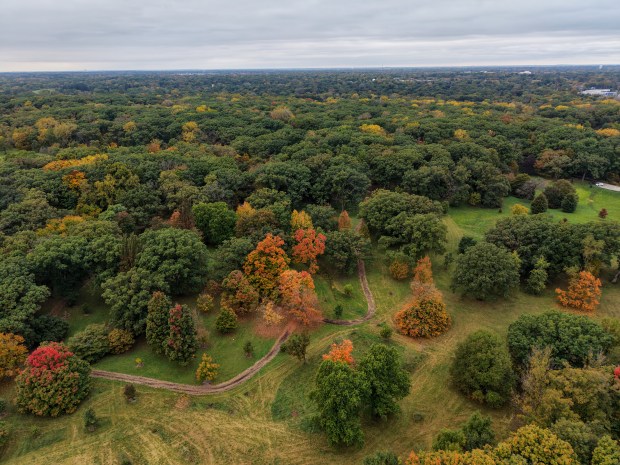
Janet Cole decided not to capture more tree photos at The Morton Arboretum. Yet an amur corktree with striking leaves caught her eye. Cole, 75, found herself once more taking pictures. “I wanted to see its beautiful, yellow colors,” she noted. Cole has volunteered at the arboretum for six years after retiring as a librarian. Her tasks include weeding and helping with events like wine tastings. She often rides her bike around, assisting visitors with questions. While usually too cold in winter, the warmth this year might allow continued cycling.
This unusual warmth delays leaf color changes, affecting plant health in the Midwest and organisms in the Great Lakes. Chicago and many parts of the globe will likely experience above-average temperatures from El Niño, according to the National Oceanic and Atmospheric Administration.
El Niño and Weather Predictions
Illinois state climatologist Trent Ford mentioned that El Niños do not reliably predict precipitation in Illinois. However, temperature predictions suggest a 70% chance of above-average winter temperatures in the Great Lakes region. “This is a solid prediction for winter temperatures,” Ford remarked.
Temperature affects trees’ color change timing, stated Michael Jesiolowski, The Morton Arboretum’s plant clinic manager. Leafs usually change when temperatures dip below freezing. As of recently, lows remained above 45 degrees. Later in the week, lows dropped to the low 40s and high 30s, according to the National Weather Service. Chicago hit a record high of 88 degrees on October 12.
On average, maples shine mid-October and oaks by late October in Chicago. At Morton Arboretum, autumn colors barely began on October 14.
Role of Different Factors
Though leaves might change later this year, they may last longer. This depends on various aspects like precipitation and sunlight. Jesiolowski mentioned, “Cool mornings and evenings influence fall color.” Currently, without freezing mornings, abundant fall colors are unseen.
El Niño-Southern Oscillation’s Impact
The El Niño-Southern Oscillation, a warming and cooling cycle in the Pacific Ocean, is a key climate influencer. It involves a warmer El Niño period, affecting global weather, and a cooler La Niña period. Experts foresee a significant El Niño, potentially the “strongest on record,” said Zack Leasor, a climatologist at the University of Missouri. The last El Niño appeared in 2023.
Mixed Agriculture Effects
While effects may be intense globally, the U.S. winter forecast predicts normal or warmer temperatures. Illinois may experience warmer conditions, with equal chances of varying precipitation. El Niño’s agricultural impact can be dual, with drought relief in some areas but adverse conditions in others.
“El Niño years see higher corn and soybean yields due to a longer growing season,” said David Zaya, botanist at the Illinois Natural History Survey. Cold springs make planting difficult on frozen fields, less so during El Niño years.
Changes in global weather through El Niño mean more rain for the Midwest. Leasor commented, “A wetter winter and spring are beneficial.” Yet, southern and western Illinois face challenges like extended droughts.
Crop Risks and Temperature Concerns
Ford warned that elevated temperatures in southern Illinois could impact perennial crops like cherries, apples, and peaches. These crops might wake up prematurely, risking freeze damage.
For staples like corn and soybeans, more pests may survive into spring, posing threats, explained Kelly Estes, entomologist at the University of Illinois. Weed survival is another concern, particularly for herbicide-resistant species like marestail.
Mild winters may result in invasive plants spreading faster. Zaya highlighted the Japanese chaff flower, taking over southern Illinois. Cold winters typically slow its spread.
Effects on Aquatic Life
Warm winters also influence aquatic organisms. Harmful algae, which consume oxygen or obstruct fish gills, pose increasing threats to the Great Lakes. In 2021, algae samples in the Illinois River showed toxin levels over 30 times higher than advised.
Warmer waters from El Niño can lead to faster plankton growth, noted Casey Godwin, research professor at the University of Michigan. El Niño patterns also impact species like lake whitefish by limiting protective ice, essential for egg survival.
Local Impacts and Garden Care
While global regions may face severe effects, Chicago expects milder impacts. Yet gardeners should note that plants may struggle with moisture retention in warmer temperatures.
Jesiolowski advised watering plants deeply weekly and applying mulch. This practice, known as “Leave the Leaves,” helps conserve moisture.
As the Morton Arboretum approaches peak tree colors, Cole remains patient. “It’s inspiring,” she reflected. “A distraction from worldly events.”
Leave a Reply