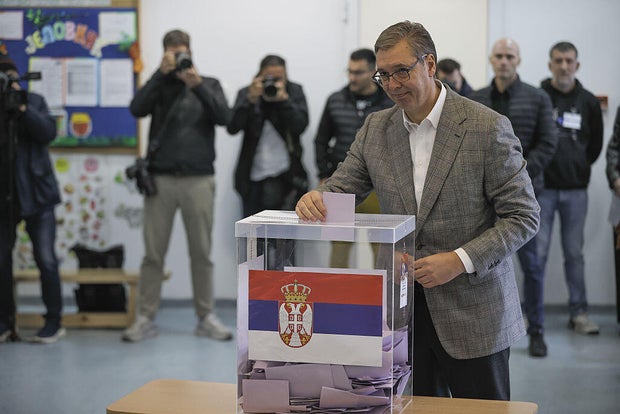
The long-time leader of Serbia, Aleksandar Vucic, admitted defeat in a pivotal election on Sunday. This election saw him and his conservative party up against a diverse opposition driven by students who had protested his rule for two years.
Serbia experienced a major political change with the election. Vucic, formerly supported by Russian President Vladimir Putin, had dismissed the student movement as an external ploy to unseat him. He had wielded dominant power in the country for 14 years. The parliamentary election witnessed high voter turnout and building tensions.
The contest was fierce between Vucic’s right-wing Serbian Progressive Party and university students who rallied against what they viewed as governmental corruption and the erosion of democracy. Serbia’s 6.4 million voters aimed to elect representatives to the 250-member Parliament.
In his concession, Vucic stated that his opponents, the youth-driven Students’ List, were expected to secure between 135 and 140 seats, whereas his own party would obtain roughly 105.
“The Students’ List has won,” Vucic declared at his party’s event, attributing the loss to Serbia’s independent media and alleged interference by unnamed European nations and an “American deep state.”
Vucic highlighted that his party garnered nearly 1.7 million votes, compared to the Students’ List’s 2.2 million. Supporters of the Students’ List celebrated in Belgrade and other cities, chanting “Aleksandar is gone.” This outcome was revealed shortly after the polls closed.
During the day, tensions mounted, and the police in riot gear secured areas around the election commission headquarters in central Belgrade. Special police vehicles were stationed near where Vucic’s supporters had camped, while groups of men dressed in black gathered in various locations.
Vucic had attempted to become Serbia’s prime minister after nearly completing two terms as president. He left his presidency last month to spearhead the campaign. Though initially retaining support, his popularity waned after a tragic incident in 2024 where 16 people died in a construction mishap blamed on corruption and cronyism. This sparked protests among the youth, attributing the catastrophe to governmental malpractice.
While Vucic maintained significant backing among some Serbians, his image as a competent leader capable of navigating global issues was largely shaped by mainstream media. The previously divided opposition had often been outmaneuvered by Vucic, but the youth movement proved to be a formidable challenge.
The Students’ List was formed by university students, with none physically appearing on the election list. Instead, candidates included experts, athletes, farmers, and artists, aiming to counter Vucic’s authoritative leadership and promote community.
The students promoted an apolitical agenda, advocating for economic recovery and democratic restoration. They attracted disenchanted voters, despite being ridiculed by pro-government channels. The youth campaigned by traveling on foot and bike to reach rural voters, traditional bases for Vucic.
This victory mirrors the recent election result in Hungary, where youth influence unseated the autocratic Viktor Orbán, heralding a pro-European administration. The Serbian election may influence wider European protests driven by youth discontent.
Election monitors projected a substantial turnout, potentially reaching 70%, unseen since 2000. Voters queued long hours, including the Serbian diaspora voting under inconvenient conditions. Previous elections faced irregularities; EU observed Sunday’s proceedings closely due to Serbia’s EU candidacy. Monitors reported issues like ballot photography, indicating voter pressures and vote-buying attempts.
Both local and international monitors expressed safety concerns due to an election campaign marred by detentions, government media control, and allegations of surveillance and cyberattacks.
Journalists and activists faced violence during early local elections, and the parliamentary vote in 2023 was marred by claims of electoral fraud, drawing significant scrutiny and protests.
Leave a Reply