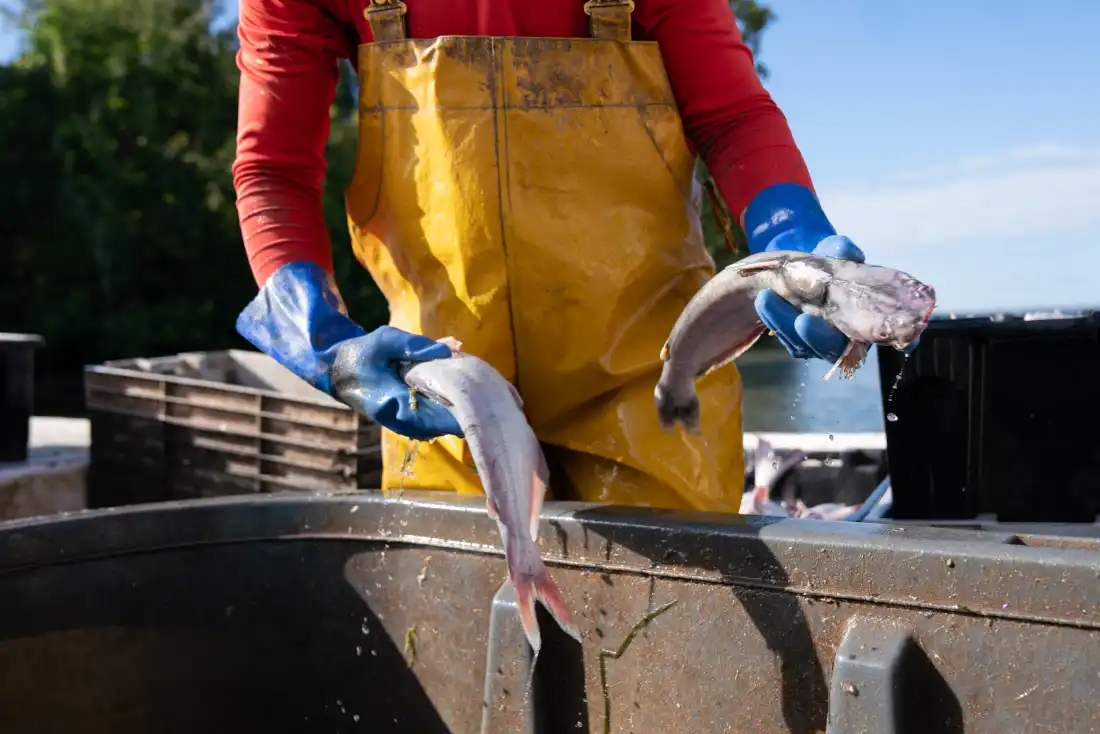
Invasive blue catfish are creating challenges in the Chesapeake Bay and its tributaries by preying on local marine life, such as the blue crab. To mitigate this issue, schools in the area, like Preston Elementary on Maryland’s Eastern Shore, are serving catfish during lunch hours.
Students at Preston Elementary recently received a unique addition to their lunch menu: catfish sandwiches. For instance, second-grader Ben Rochon enjoyed the offering, casually announcing, “I got a catfish sandwich!” Others, like fifth-grader Teagan Donovan, preferred to eat it plain, highlighting the catfish’s inherent taste.
However, the introduction of catfish sandwiches does face competition from other popular options like pizza. Despite children’s varied preferences, there has been an increase in students trying the blue catfish meals served twice monthly. This aligns with the goals of Beth Brewster, who manages food services for Caroline County Public Schools. Brewster has played a pivotal role in promoting this initiative, motivated by the catfish’s taste and the ecological benefits of consuming it.
Brewster developed the “catty patty,” a fishcake made from blue catfish, as part of her strategy. This creative dish meets federal dietary guidelines and has received support for its potential to curb the blue catfish population.
Asked by state officials about eight years ago to help address the invasive species dilemma, Brewster’s partnership with the schools has shown promising results. Furthermore, thanks to a collaboration with the Bay2Tray program, other schools in Maryland and Virginia have also introduced blue catfish meals.
The Blue Catfish Invasion
Originally introduced for recreational fishing in the 1970s, blue catfish have spread widely throughout the Chesapeake due to unforeseen circumstances, such as the significant rainfall in 2018. Today, they inhabit every tidal tributary of Maryland, comprising a large percentage of the fish biomass in some areas. Alarmed by the potential ecological and economic impacts, officials are now counting on human consumption to help control their population.
This problem is not unique to Maryland. Other states are also enlisting human involvement to manage invasive species, such as the Asian carp in Kentucky and Illinois, or green crabs in Maine and Washington.
Local Watermen Adjusting to Changes
On the Potomac River, fourth-generation Maryland waterman Rocky Rice now dedicates his efforts predominantly to catching blue catfish, given their year-round availability and absence of catch restrictions. Originally a seasonal activity to complement crabbing, targeting catfish has now become his primary focus due to steady demand.
The fish market, while not offering high prices, remains sustainable due to consistent catches. For Rice, blue catfish is not only a job but also a personal favorite dish, which he enjoys deep-fried.
Overcoming Processing Challenges
While catching these fish remains unrestricted and profitable, processing them presents hurdles. Blue catfish require USDA inspection, a laborious process that only a few processors in the area can manage. Despite this, the fish finds its way to various markets and institutions.
Programs like Bay2Tray are working to create new markets for the fish, underscoring the practicality of utilizing blue catfish as a sustainable protein source. As noted by Jenn Lovewell from Real Good Fish, significant harvesting is required to maintain balance in the region’s marine ecosystem. Both Lovewell and Brewster encourage consumers to “eat the problem and save the bay.”
Leave a Reply