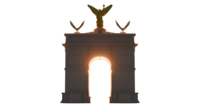
Washington, D.C.’s monumental core is a showcase of precise geometry and intentional sight lines. From the Lincoln Memorial, across a bridge over the Potomac, Arlington National Cemetery rises prominently. President Donald Trump’s proposed 250-foot-tall arch threatens to alter this landscape. To assess its impact, The Washington Post created a digital 3D model to scale.
The analysis revealed that the arch’s shadow would touch Arlington National Cemetery for 284 days each year. It would briefly cover Kennedy’s eternal flame on 18 days and shade his memorial for 50. The Military Women’s Memorial would face shadowing on 109 days. The arch would also cast shadows over the graves of veterans and significant historical figures from various wars, affecting more than 75,000 graves.
By 8 a.m. on most days, the shadow would retract from the cemetery. However, on 26 days, it would persist past this time. Regarding the findings, White House spokesman Davis Ingle stated via email that the arch would “enhance the visitor experience” at the cemetery, describing it as a future iconic landmark in Washington, D.C., and globally.
The Interior Department noted that their design models indicated minimal impact on the cemetery, claiming shadows would be short-lived and distorted. However, the provided visual simulations did not adequately explain their methodology and showed similar shadow locations to those found by The Post.
The scale and location of the arch, about a quarter-mile from the cemetery, worry historians and architects. They argue it disrupts the carefully curated composition of Washington’s design. Neil Flanagan, an architect and historian, emphasized that the original planners valued open spaces between landmarks as much as the structures themselves.
Critics like Micki McElya, a history professor, highlighted the discomfort of having Trump’s arch cast shadows over the cemetery, which symbolizes American sacrifice. Paul Eaton, a retired Army major general, called the shadowing of veterans’ graves “a sacrilege” and expressed concern about personal visits overshadowed by what he terms a “vanity project.”
Despite opposition, Trump remains firm, seeking to surpass the Arc de Triomphe’s height. His administration aims to ease approval processes by relaxing construction height restrictions in Washington, D.C. A federal judge currently considers a lawsuit from Vietnam War veterans and a preservationist against the project.
The arch affects shadows significantly if daylight saving time becomes permanent, potentially altering cemetery visits. Jacqueline Kennedy’s wishes for the visibility of Kennedy’s eternal flame could be impacted. The administration plans its eternal flame for Trump’s arch, symbolically overshadowing Kennedy’s memorial.
The eternal flame burns in Arlington in 2013, marking the 50th anniversary of President John F. Kennedy’s death.
The Post’s analysis, utilizing triumphal arch plans, USGS data, and NOAA simulations, paints a detailed picture of the shadow’s reach. Its findings align with existing landmark shadows and disregarded tree shadows for clarity. Arlington National Cemetery Explorer data helped quantify the graves affected.
Leave a Reply