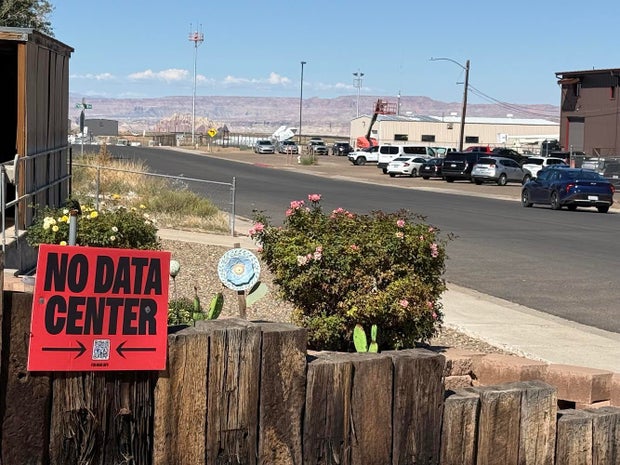
Doug Herrera continues to live in the house his father built, although his father passed away from cancer some time ago. Herrera suspects the illness might have been linked to pollutants from nearby uranium mining. Now, he’s worried about a proposed $10 billion mega data center that could threaten his health.
“I’m a patriot, but I’m highly against the data center,” Herrera, 64, remarked from his porch. He is concerned about light pollution, sound pollution, and an increase in temperature.
Page, Arizona serves as a gateway to stunning Southwestern landscapes. While the City Council has approved the land sale for the data center, the developer still requires zoning and other approvals.
Residents have mobilized opposition due to concerns about potential health effects, collecting signatures for petitions.
Data center expansion is dividing communities like Page and creating contentious issues in upcoming elections. Arizona’s 1st Congressional District candidates have opposing views on these centers. The state’s attorney general suggests pausing new approvals and construction.
The developer purchased 500 acres for the proposed center. Emerging research on health effects linked to data centers is fueling debates, even affecting positions of politicians in traditionally red states like Ohio and Texas, where data centers are prevalent.
“Two years ago, many data centers were built without organized opposition,” said Lee Hannah, a political science professor at Wright State University.
Massive centers house technology infrastructure for AI, covering tens of thousands of square feet. The city has approved land sale for the center, but the exact location hasn’t been finalized.
Data centers consume significant electricity and use gas generators during peak energy demand periods. Environmental studies associate resulting air pollution with health risks like heart conditions and cancer.
A University of California-Riverside study projects nearly 1,300 annual deaths and a public health cost exceeding $20 billion by 2028 due to emissions from these centers. Cooling components may contain “forever chemicals” accumulating in human tissue.
Sound levels from operational generators can harm hearing with decibels exceeding 90. Data centers contribute to light pollution, which some claim increases risks of chronic disease. They also create “data heat islands,” higher temperature zones due to energy demand.
“We’re seeing early research into the health impacts of data centers,” said Alison Steele, executive director of the Environmental Health Project.
The Data Center Coalition ensures responsible operations and minimal use of backup diesels.
Concerns over data centers divide political candidates, including GOP figures opposing President Trump’s support for these structures.
A Washington Post-ABC News-Ipsos poll indicates that two-thirds of Americans oppose new data center construction. Political tensions are evident especially in states won by President Trump, forming 60% of planned data center capacity.
Lee Hannah highlights how concentration of centers in rural, strongly Republican areas poses a risk for Trump’s coalition.
Signs opposing construction are evident across Page, Arizona, indicating political risks for GOP candidate Jay Feely, an endorsed candidate of President Trump. Democratic opponent Amish Shah advocates pausing construction.
The competitive House seat contested by Feely and Shah may influence party control after midterms, as 57% of Arizona voters oppose more large data centers.
Photos of politicians at data center groundbreaking ceremonies are now being used as campaign materials.
Data center concerns also impact Ohio’s Senate race, with Democrat Sherrod Brown attacking Republican Jon Husted over pollution and environmental impacts.
“They’re devouring farmland, sucking up water, and consuming energy,” says Brown in campaign ads.
Data centers’ growth in Ohio sparks local voter initiatives concerning their health, environmental, and financial impacts.
An August memo from the National Republican Senatorial Committee highlights Husted’s challenges concerning data centers.
Jon Husted reframes data center construction as a local issue, emphasizing infrastructure costs coverage by companies.
An Ohio Northern University and SurveyUSA poll shows 55% opposition to data centers among surveyed Ohio adults.
Concerns include pollution from gas turbines linked to cardiovascular problems and chemical contaminants affecting water supply.
“Diesel-fired generators emit pollution like nitrogen oxide,” remarks Shaolei Ren, professor of electrical engineering at the University of California-Riverside.
Page residents recently changed mayoral leadership due to backlash over data center land sales. Opponents consider this a warning for candidates backing construction.
Concerns persist among Page residents about potential health impacts if the project proceeds. Jan Boehme, living near the site, expresses worry about noise pollution.
KFF Health News produces detailed journalism on health issues, operating as a core program at KFF.
Leave a Reply