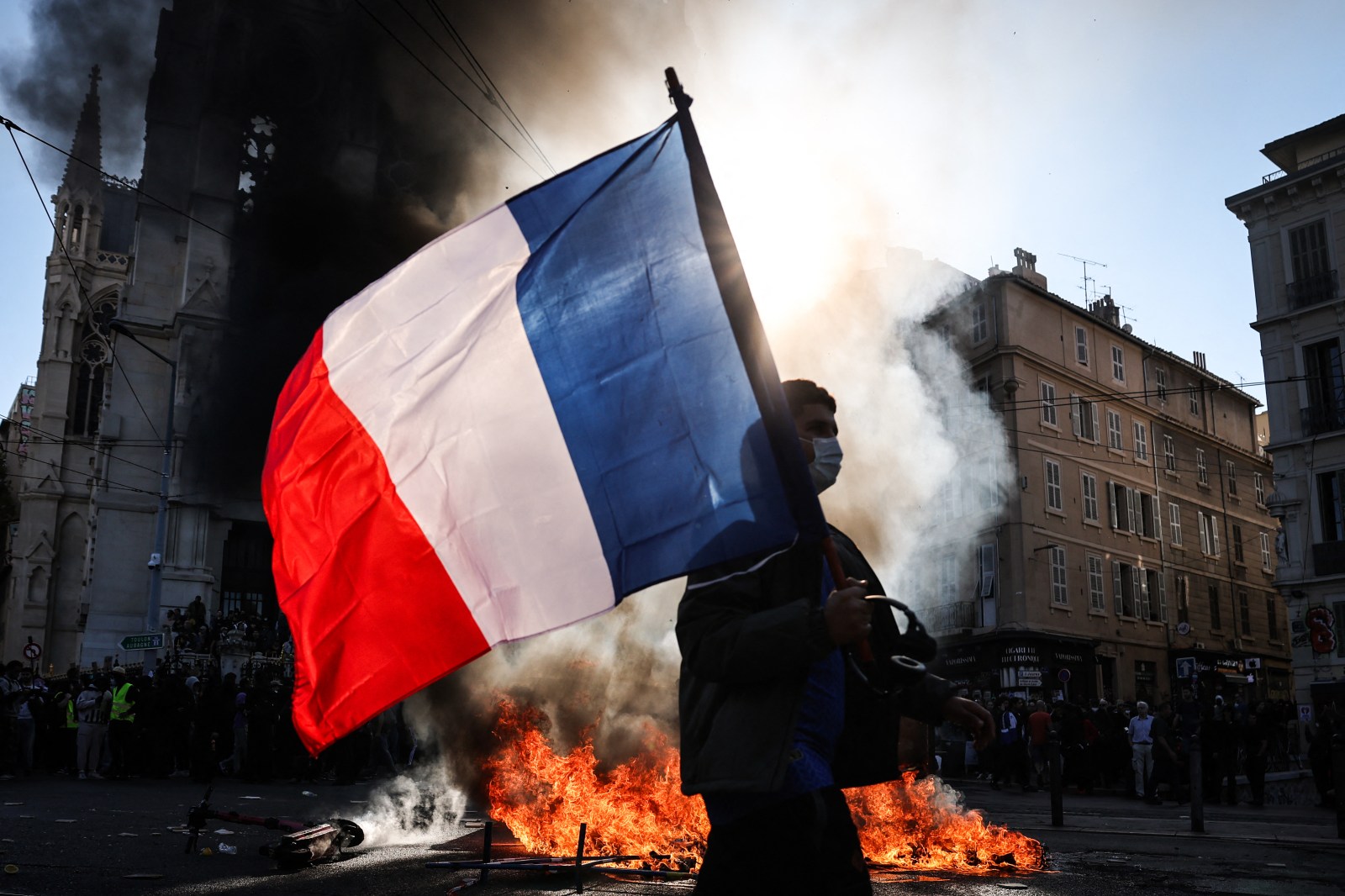
Nationwide Protest Over Economic Hardships
On October 17, a significant demonstration occurred in France, where more than half a million people took to the streets to protest rising living costs and declining education standards. By the end of the day, chaos had erupted, notably in Limoges, where the town hall witnessed severe damage. The result of this unrest led to nearly 2,400 arrests. Roughly 1,000 law enforcement officers and firefighters sustained injuries. Thousands of businesses suffered from vandalism and looting, while numerous cars were set ablaze.
Warnings of Organized Exploitation
These events are part of a larger pattern of protests, but the spread beyond France’s borders raises critical questions. Concerns arise about the impact of radical movements that exploit legitimate grievances to undermine societal structures. Prime Minister Sébastien Lecornu spoke to parliament about far-left groups pursuing insurrection. Intelligence reports suggest possible attempts to cause disarray leading into next year’s presidential election. President Emmanuel Macron accused activists of targeting police and public facilities. The interior minister acknowledged a loss of control in major urban areas.
Question of Financial Backing and Influence
While public protest is a democratic right, the potential exploitation by organized radical and Islamist groups poses significant consequences. Questions about financial backing arise, with reporting identifying 54 organizations connected to the demonstrations. Only a minority were student or youth groups, with others consisting of political, communist, Islamist, and revolutionary alliances. Transparency is crucial when identifying connections between groups and violence.
Investigations have highlighted figures such as Neville Roy Singham, a tech mogul whose nonprofit Tricontinental supports the protests. Concerns about links to the Chinese Communist Party add to the scrutiny. This should prompt further investigation, given the worldwide implications of these connections.
Global Implications and Domestic Challenges
Globally funded radical groups have consequences domestically. Progressive organizations have backed actions like the harassment of Immigration and Customs Enforcement (ICE) agents. The financial pressure, such as that applied by the Sunrise Movement against hotels housing ICE agents, impacts ordinary citizens, including hotel workers and business owners.
The convergence of Marxist revolutionaries, Islamists, and anti-Western regimes focuses on weakening institutions. Cooperation between these groups necessitates investigation and legal action. Noted by the Trump administration, the concept of “thumos,” emphasizing passion, strength, courage, and pride, provides a framework for addressing these challenges.
America’s Choice and The Path Forward
Historical lessons from American riots illustrate how public order can quickly collapse. Violent protests can easily shift focus from defending citizen rights to unchecked chaos that hampers prosperity. Americans must decide whether to maintain civil society or let extremism erode it. This requires transparency, law enforcement, and preservation of peaceful protests.
The article emphasizes that socialism and radical extremism subordinate individual rights for movement objectives, advocating that America First prioritizes citizens first. The shared commitment represented by ‘E Pluribus Unum’ underscores the value of a nation where individuals can freely live, work, and express opinions without fear of mob rule.
“A civilization does not collapse overnight. It weakens when leaders excuse disorder, institutions retreat, and citizens lose the will to defend what generations built.”
A choice must be made between allowing intimidation to hollow out civil society or striving for greatness through unity and courage.
Chad Wolf serves as chair of Homeland Security and Immigration Policy and the Western Hemisphere Initiative at AFPI, and previously held the position of acting U.S. Secretary of Homeland Security.
Leave a Reply