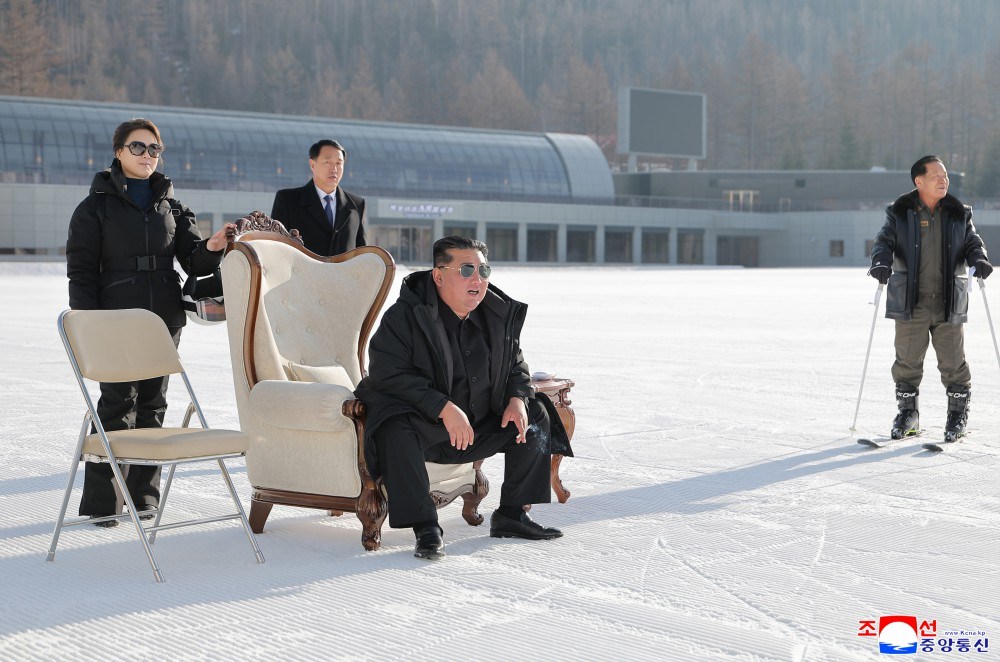
On his journey to Asia, U.S. President Donald Trump departed Washington on a noteworthy visit, while North Korean state media broadcast images of Kim Jong Un enjoying a moment at a ski resort near the Chinese border. Wearing sunglasses and seated in a leather chair, Kim, cigarette in hand, witnessed his daughter, Ju Ae, ski without a helmet. However, this leisurely appearance was part of an official visit to a new tourist facility that might be brief.
Trump remarked that there was a possibility Kim could attend the APEC summit in Shenzhen, but that decision was ‘up to President Xi.’ Meanwhile, Russia announced that President Vladimir Putin might meet Kim if he appeared. Despite these speculations, a researcher from a Seoul-based think tank observed no signs of summit preparations, and South Korean Foreign Minister Cho Hyun diminished the prospect of a Kim-Trump meeting.
Nevertheless, indications suggest Kim could arrive, and if he does, nuclear weapons discussions with Trump would be unavoidable. The history between the two leaders includes Trump’s 2017 nickname for Kim, ‘Little Rocket Man,’ which Kim partly objected to, noting his disapproval of the term ‘Little.’
“‘Rocket man,’ OK. ‘Little,’ not OK.”
Today, Kim’s arsenal is expanding. The Stockholm International Peace Research Institute estimates that Kim possesses about 60 nuclear warheads and enough material for more. Trump needs to rethink American policy towards Kim’s nuclear ambitions. The trilateral summit with Xi and Putin aims to focus on nuclear arms control issues.
Trump acknowledged the difficulty in reducing nuclear arsenals, yet a comprehensive denuclearization strategy should be a long-term vision. An interim, verifiable deal that slows Kim’s nuclear advances is crucial. The International Atomic Energy Agency (IAEA) recently disclosed from satellite information that North Korea has another uranium enrichment site at Yongbyon.
Although Washington proposes talks without any expectations, the goal remains denuclearization. South Korea and Japan have reiterated this stance. Yet, Kim suggests he is open to dialogue if the U.S. drops its unwavering demand for disarmament. The South Korean Unification Minister stated denuclearization shouldn’t precede negotiations.
Victor Cha, a former Bush White House official, proposes a ‘cold peace,’ shelving disarmament for now. Even Rubio, once a strict critic, acknowledged Kim’s nonexpansionist aims. A smaller agreement wouldn’t require the transfer of a single warhead, contingent on a freeze on fissile materials.
- Inspectors return to Yongbyon and enter Kangson.
- Declaration of all nuclear sites, with inspection rights.
- Long-range missile launch and nuclear test moratoriums.
- Communication lines to prevent accidental conflict.
- Partial sanctions relief for verified steps.
In Hanoi 2019, Kim offered to dismantle Yongbyon in exchange for easing some economic sanctions. Trump opposed this, citing discoveries beyond Yongbyon. A precise approach is necessary, ensuring every action justifies a transparent reward. Washington should avoid agreements ending at already known sites.
Yet, a risk remains. Recognizing Kim’s arsenal could embolden him. A South Korean ambassador suggested Kim may demand further concessions while expanding forces. A former Japanese diplomat argued that a tactical pivot may not yield compliance from Kim, while U.S.-Israeli conflicts with Iran could send a message to other nuclear-aspiring nations: accelerate development.
However, acknowledging the arsenal doesn’t equate to acceptance. The Non-Proliferation Treaty limits official nuclear states. Any agreement needs careful negotiation. South Korea would benefit more from a fissile freeze than from missile limitations, considering its proximity to potential threats. Relief from sanctions must be cautious and adaptable, and alliances shouldn’t be weakened.
In August, Trump reduced military exercises with allies, citing favorable relations with Kim. The current scenario might prompt Kim to repay previous concessions. Inspected freezes provide more security against emerging threats than expanding arsenals.
If Kim remains uncooperative, or demands too high a price, dialogue offers little benefit, and Trump’s response should reflect that. Continuing unchecked nuclear progress poses a direct threat, which a verified freeze could mitigate. Ultimately, the aim is containing Kim’s arsenal to limit its growth as much as diplomacy allows.
Leave a Reply