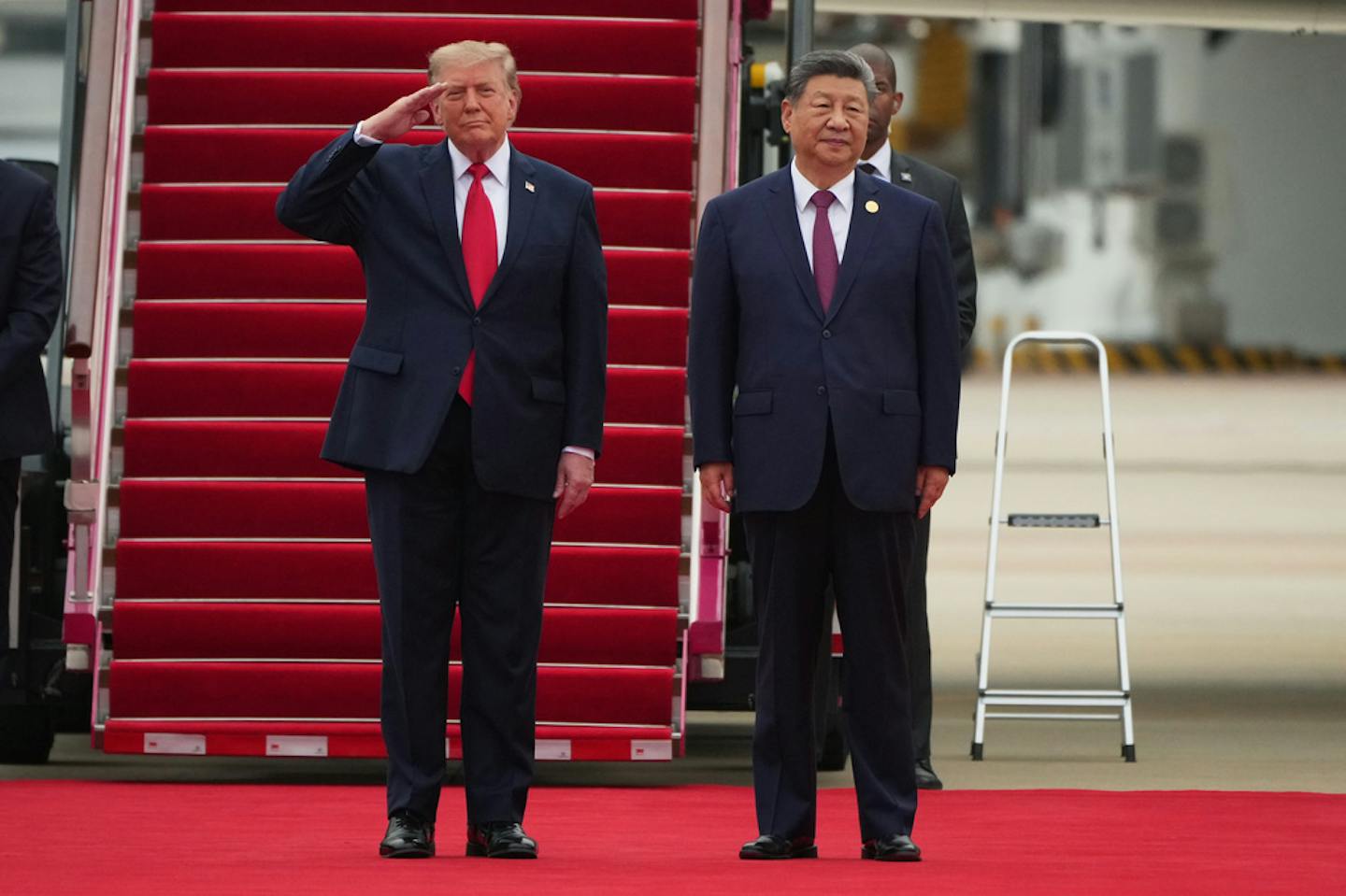
President Donald Trump arrived in China on Wednesday. His goal was to reinforce the United States’ position as a leading technology power. However, a series of technical outages in the U.S. brought challenges. These disruptions made the administration work to reassure the American people.
As Trump stepped off Air Force One at Shenzhen Bao’an International Airport in southern China, he was greeted by China’s President Xi Jinping. This gesture returned the honor from a previous U.S. visit by Xi. The timing was critical as Trump aimed to project strength ahead of a planned trilateral meeting with China’s Xi Jinping and Russia’s Vladimir Putin.
Initially, Trump downplayed the outages while in Manila, referring to them as part of being a “big and powerful” nation. But the disruptions involving entities like Microsoft, the FAA, and the NSA created public concern. Secretary of State Marco Rubio reassured the public, stating there was “zero” evidence of foreign involvement.
Trump’s visit centers on acting with flexibility in Shenzhen, a tech powerhouse. His unscripted diplomacy aims to leave a legacy in reshaping global affairs in his last two years as president. Before the official APEC greeting ceremony, Trump planned discussions with Mexican President Claudia Sheinbaum and Canadian Prime Minister Mark Carney.
A significant meeting is set for Thursday. Trump intends to discuss nuclear arms and the Ukraine conflict with Xi and Putin. Though not on the original agenda, Trump expressed optimistic views on resolving the Ukraine crisis. He mentioned the heavy casualties among Russian troops as an opportunity to end the conflict.
While in Manila, Trump met with President Ferdinand Marcos Jr. at the Malacañang Presidential Palace. They discussed U.S.-Philippines relations and reportedly reached a trade deal. A brief meeting also took place with Imelda Marcos, highlighting longstanding personal connections.
The upcoming meetings with Xi and Putin raise concerns. Trump’s approach to the U.S.’s traditional allies contrasts with his engagement with these geopolitical rivals. His tariffs against China have not curtailed its manufacturing dominance. Moreover, artificial intelligence (AI) developments present economic and security challenges at the summit.
Jensen Huang’s recent removal as Nvidia CEO due to alleged ties with a Chinese agent underscores these tensions. Trump noted internal disagreements on how to address China’s access to advanced chips. Such complexities add another layer to the discussions in Asia.
Leave a Reply