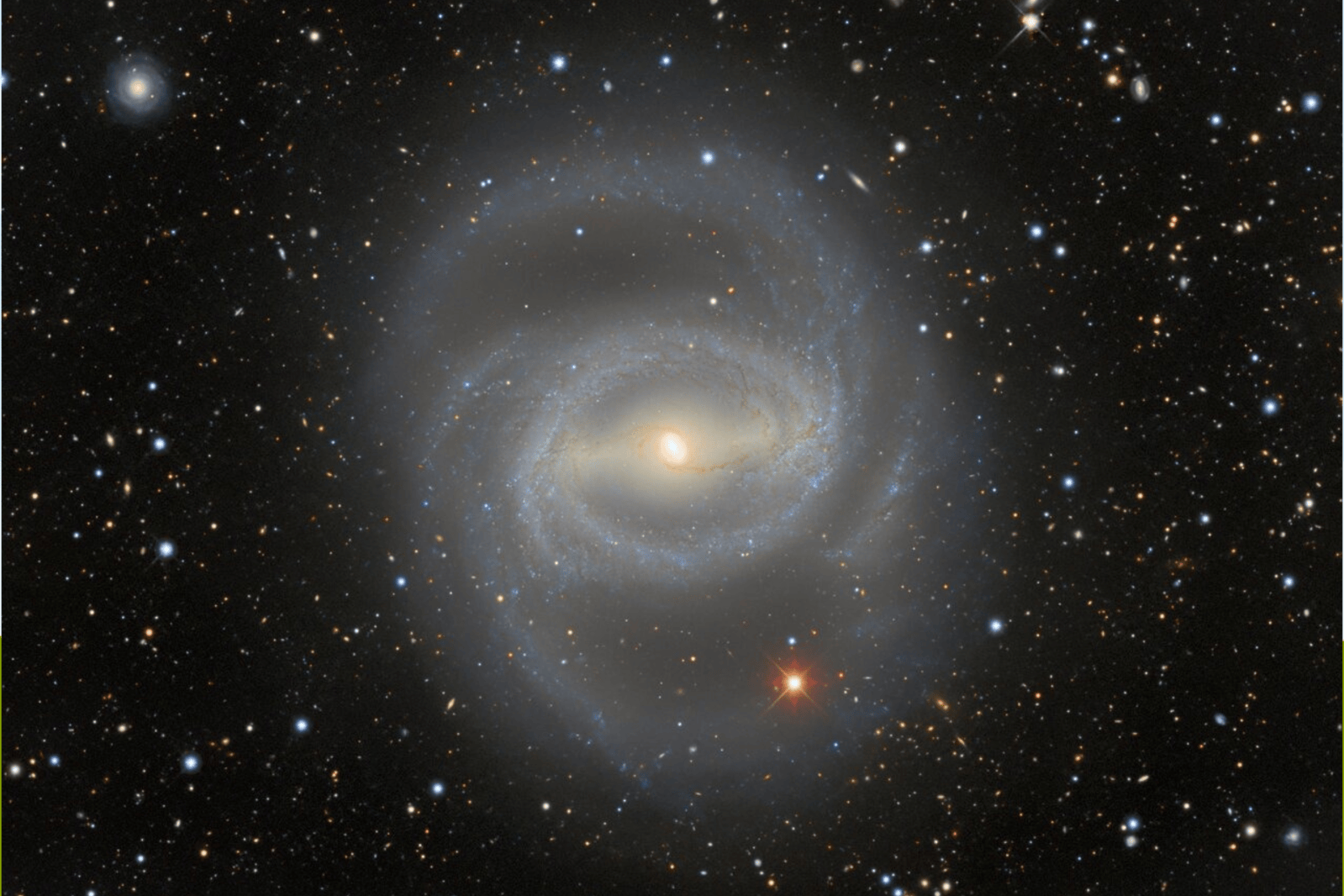
Astronomers are currently observing a newly detected supernova, or star explosion, located in a galaxy approximately 50 million light-years from Earth. This means the light from this explosion started traveling toward us around 50 million years ago, soon after the dinosaurs’ extinction. The early discovery provides a unique chance for scientists to understand the development of such explosions.
The supernova, named SN 2026ahvu, occurred in NGC 1433, a spiral galaxy within the constellation Horologium, also known as the Pendulum Clock. The Asteroid Terrestrial-impact Last Alert System (ATLAS) first observed SN 2026ahvu on November 2, as reported by the International Astronomical Union’s Transient Name Server.
ATLAS initially measured the object’s brightness, or apparent magnitude, at about 17. Magnitude is a scale astronomers use to indicate how bright an object appears from Earth. Lower numbers signify brighter objects. For example, the sun has an apparent magnitude of around -27, and a full moon is about -12.6. In a few days, the supernova brightened to a magnitude of 13.5, as reported by the National Science Foundation’s NOIRLab.
Further observations confirmed SN 2026ahvu as a “Type Ia supernova.” This type of supernova involves a white dwarf—what remains after a star similar to our sun exhausts its fuel—as described by NASA. A Type Ia supernova results from the thermonuclear destruction of a white dwarf. This can occur if the white dwarf pulls material from a companion star, leading to an uncontrollable nuclear reaction.
Although scientists know the type of explosion SN 2026ahvu is, the specific trigger for its detonation remains unclear. NOIRLab notes that this type of explosion involves a nuclear reaction that can happen if the white dwarf consumes enough material from a nearby star.
The proximity of SN 2026ahvu makes it noteworthy. While 50 million light-years is distant, it is relatively close for astronomical phenomena. NOIRLab considers it one of the closest Type Ia supernovae observed since SN 2011fe in the Pinwheel Galaxy in 2011.
More crucially, the supernova was detected early. When ATLAS announced the discovery, it was still young and intensifying in brightness. This early detection allows scientists to observe the supernova’s transformation over time. NOIRLab highlights that early characteristics of the explosion may vanish quickly as ejected material expands.
Astronomers have already captured images with the Dark Energy Camera on the Víctor M. Blanco 4-meter telescope in Chile and the Gemini South telescope. NOIRLab forecasts that the supernova will peak in brightness between November 18 and 23, reaching an apparent magnitude of 10.5 to 12.1.
Researchers will continue observing the supernova as it gradually fades, comparing pre-explosion data with observations during and after SN 2026ahvu’s brightest phase. These comparisons aim to enhance understanding of the star system responsible for the supernova and the underlying mechanics of Type Ia supernovae.
Leave a Reply